
Answer: Measure the finished internal space after a door or drawer is installed. Hinges, runners and the drawer’s own walls can remove usable space from an otherwise suitable cube.
BoardFit Atlas editorial project · Updated October 21, 2026 · Original decision framework and illustrative example. No physical product measurement or hands-on benchmark is claimed.
On this page: Why the distinction matters · A practical sequence · Decision record · Worked example · Verify the result · Question and answer · Sources and scope
Why the distinction matters
An accessory marketed for a shelving family does not retain the empty cube’s dimensions. Doors create an entry path, drawers create a smaller container, and handles may collide with nearby objects. Start by deciding whether you need dust screening, concealed storage or quick access; each changes the useful layout. The accessory’s compatibility with the furniture says nothing about compatibility with a particular game.
A practical sequence
- Identify the shelf and accessory product codes and follow their installation instructions.
- Measure inside the installed accessory at its narrowest and shortest points. Include the opening arc or pull-out path.
- Trial the largest packed game in the intended orientation, keeping its base supported.
- Close the door or drawer without pressure and retrieve the box again. Document any layout restrictions.
Decision record
| Check | What it means | What to verify |
|---|---|---|
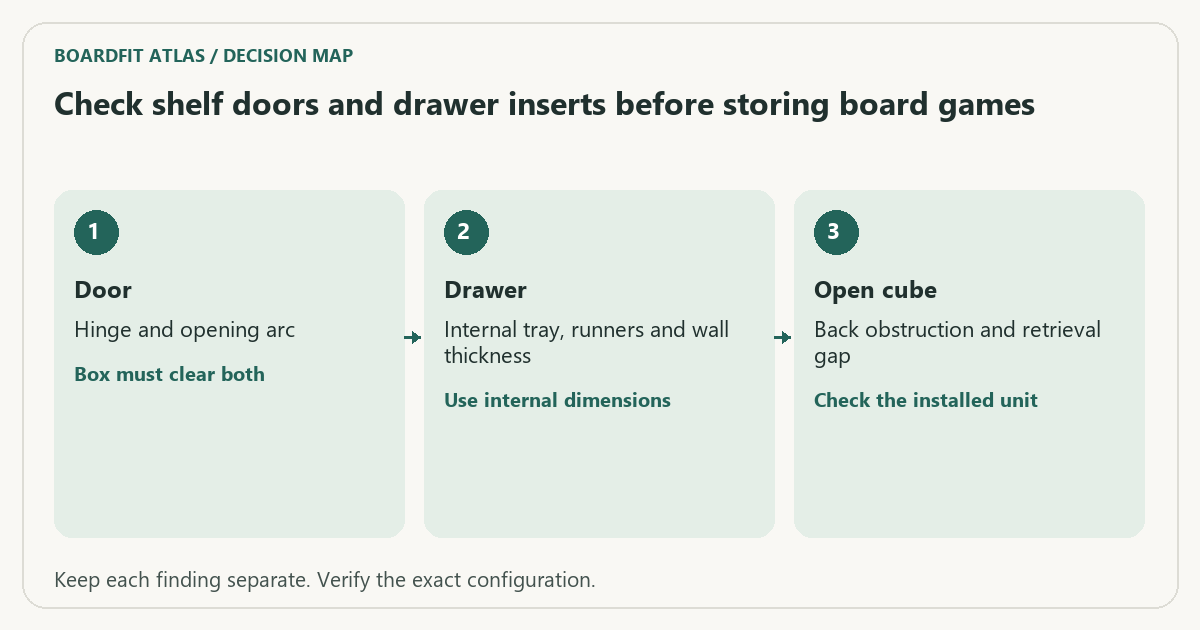
| Door | Hinge and opening arc | Box must clear both |
| Drawer | Internal tray, runners and wall thickness | Use internal dimensions |
| Open cube | Back obstruction and retrieval gap | Check the installed unit |
Worked example
Suppose an empty cube has a 330 mm opening but a hypothetical drawer has only 300 mm usable width. A 315 mm game can fit the empty cube and fail inside the drawer. Comparing the game to the accessory’s advertised outer width would miss the failure. These are teaching dimensions, not specifications for an IKEA accessory.
Verify the result
Keep a separate inventory location for each drawer. Position labels where you can read them without opening every container. If vertical storage spills components, solve containment inside the game before concealing it behind a door.
Download the editable CSV worksheet · Box-fit workbook
Question and answer
Is a basket a direct substitute for a drawer? It can remove different amounts of space and have a different retrieval path. Measure the basket interior and its loaded shape.
Sources and scope
- IKEA US: KALLAX buying guide, January 2026 — Manufacturer dimensions and installation guidance; measure your installed unit and read its own instructions.
The decision sequence, diagrams, worksheet and worked case are our editorial work. AI assisted research, drafting and implementation. Official references support the named technical distinctions; examples do not establish real product performance.
Continue the task
- Horizontal or vertical storage: evaluate containment
- Bags or removable trays? Choose by the setup task
- Browse the complete resource library
Build on what you just learned
Your next useful step.
Leave space for retrieval, growth and a safe load.

Is the Wingspan Nesting Box worth the shelf space?
I would consider the Nesting Box for a Wingspan collection that is already spread across several frequently used boxes.
Read the guide →Allow retrieval clearance around a tightly fitted game box
Measure the box in its packed state, then reserve space for your actual grip and removal path. Zero geometric clearance can leave a box…
Read the guide →