
Answer: Measure the box in its packed state, then reserve space for your actual grip and removal path. Zero geometric clearance can leave a box that enters the shelf but is difficult to remove.
BoardFit Atlas editorial project · Updated October 21, 2026 · Original decision framework and illustrative example. No physical product measurement or hands-on benchmark is claimed.
On this page: Why the distinction matters · A practical sequence · Decision record · Worked example · Verify the result · Question and answer · Sources and scope
Why the distinction matters
There is no universal finger-gap value that suits every box, shelf and person. A textured lid, a protruding tray and a deeply recessed shelf all change the movement. Measure the narrowest part of the opening and inspect the route out of it. An exact catalog measurement does not include your installed doors or the lid position of an overfilled box. Support the trial box with both hands rather than pulling only on the lid.
A practical sequence
- Measure width, height and depth at the limiting points, including the packed lid.
- Choose the intended orientation and identify where you will hold the base.
- Try removal with a lighter or empty equivalent before loading a heavy game. Keep neighboring boxes supported.
- Record the clearance that worked for you, including any door position and the landing surface.
Decision record
| Check | What it means | What to verify |
|---|---|---|
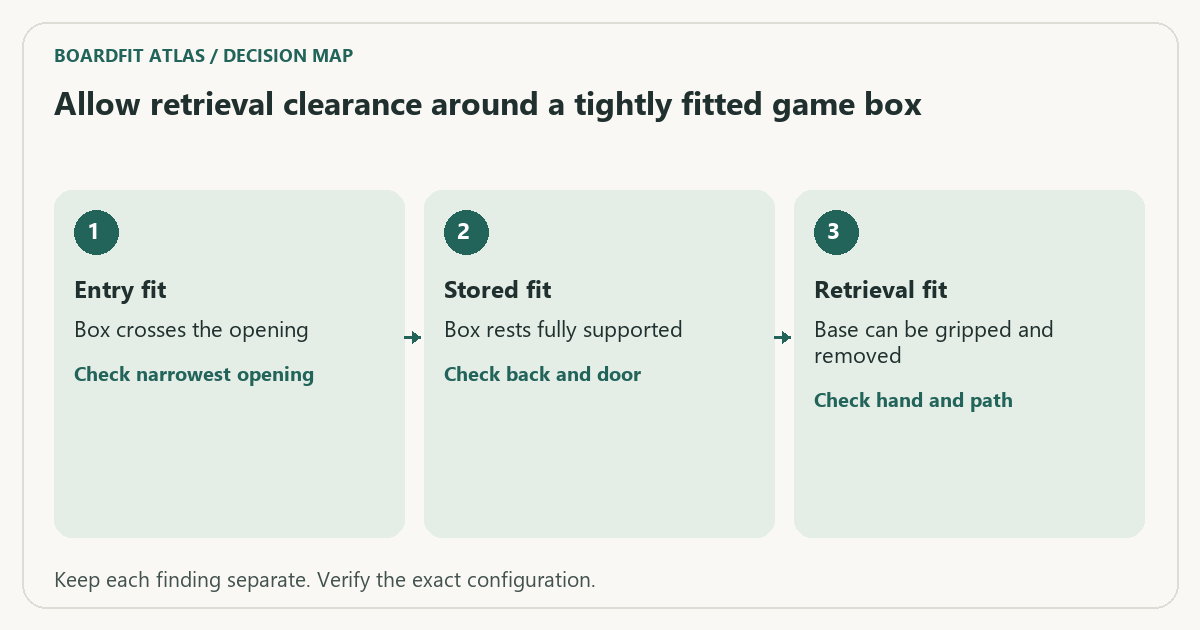
| Entry fit | Box crosses the opening | Check narrowest opening |
| Stored fit | Box rests fully supported | Check back and door |
| Retrieval fit | Base can be gripped and removed | Check hand and path |
Worked example
In an illustrative opening 330 mm wide, a 326 mm box leaves 4 mm total, or 2 mm per side when centered. That is geometric spare width, not a proven hand clearance. A planned pull tab around the base might help in one arrangement, but it needs its own supported trial and must not distort the box.
Verify the result
Put retrieval clearance in the measurement notes rather than silently adding it to the box dimensions. This preserves the real measurement and makes your planning allowance visible to someone checking the same shelf.
Download the editable CSV worksheet · Box-fit workbook
Question and answer
Can I simply subtract a fixed 5 mm from every shelf? Use a personal planning allowance if useful, but label it as your assumption and verify it with the actual movement.
Sources and scope
- IKEA US: KALLAX buying guide, January 2026 — Manufacturer dimensions and installation guidance; measure your installed unit and read its own instructions.
The decision sequence, diagrams, worksheet and worked case are our editorial work. AI assisted research, drafting and implementation. Official references support the named technical distinctions; examples do not establish real product performance.
Continue the task
- How to measure a board game box inside and out
- Check shelf doors and drawer inserts before storing board games
- Browse the complete resource library
Build on what you just learned
Your next useful step.
Leave space for retrieval, growth and a safe load.

Is the Wingspan Nesting Box worth the shelf space?
I would consider the Nesting Box for a Wingspan collection that is already spread across several frequently used boxes.
Read the guide →Silica gel in a game box: useful buffering is not a cure for damp storage
I would fix the storage environment and measure conditions before adding desiccant packets to every game.
Read the guide →