
Answer: Use bags when flexible grouping matters and trays when the same group needs to reach the table ready to use. Compare sorting, table space and teardown effort with the same game state.
BoardFit Atlas editorial project · Updated October 21, 2026 · Original decision framework and illustrative example. No physical product measurement or hands-on benchmark is claimed.
On this page: Why the distinction matters · A practical sequence · Decision record · Worked example · Verify the result · Question and answer · Sources and scope
Why the distinction matters
An organizer can shorten one stage and lengthen another. A single bag of mixed resources is compact but transfers sorting to setup; many tiny containers can reduce sorting while adding lids and table clutter. Write the recurring task first: a player kit, a common supply, or a campaign reserve. The appropriate boundary is the group you actually handle, which may differ from the component list’s manufacturing categories.
A practical sequence
- List the groups you repeatedly distribute at setup and recollect at teardown.
- Make one reversible bag arrangement and one tray arrangement using components you already own.
- Time opening, sorting and placing separately, with an identical start state.
- Pack both arrangements and compare closure, component access and the next setup.
Decision record
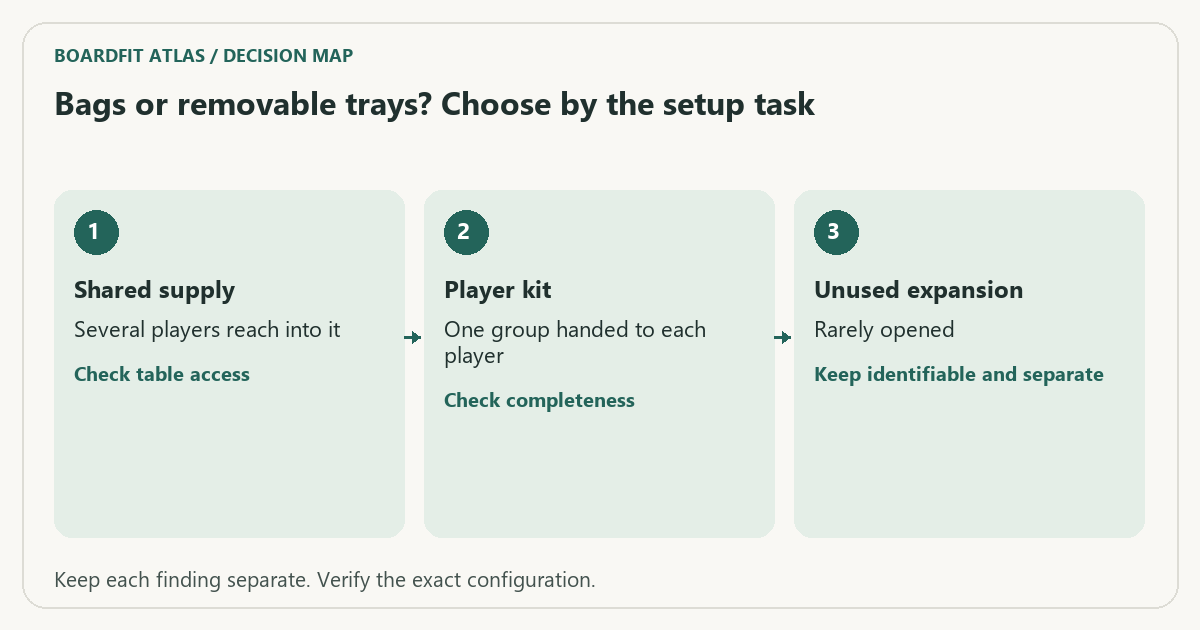
| Check | What it means | What to verify |
|---|---|---|
| Shared supply | Several players reach into it | Check table access |
| Player kit | One group handed to each player | Check completeness |
| Unused expansion | Rarely opened | Keep identifiable and separate |
Worked example
An invented comparison has bag setup at 4 minutes and teardown at 3 minutes; trays take 2 and 6 minutes. The total is 7 versus 8 minutes, so faster setup alone does not establish a faster session. You may still prefer trays when the table is ready before guests arrive, but explain that preference instead of calling them universally faster.
Verify the result
Save all observed runs when you make a real comparison. Keep game rules unchanged and avoid mixing hidden components with visible supplies. Treat a supplier’s ready-to-play claim as something to verify for your own edition and player count.
Download the editable CSV worksheet · Box-fit workbook
Question and answer
Should every token type have its own tray? Only if that grouping helps play or counting. Several tiny trays can be less convenient than one divided common supply.
Sources and scope
- Folded Space: Tapestry insert — An example of configuration-specific packing information, not universal insert compatibility.
The decision sequence, diagrams, worksheet and worked case are our editorial work. AI assisted research, drafting and implementation. Official references support the named technical distinctions; examples do not establish real product performance.
Continue the task
- Board game compatibility: check the whole configuration
- Build complete player kits without hiding shared components
- Browse the complete resource library
Build on what you just learned
Your next useful step.
Choose trays around the way you actually play.
Token Silo or Token Silo XL? Choose the tray layout before the bigger box
I would choose the original Token Silo for a modest shared supply of small tokens, and the XL when long components or several card…
Read the guide →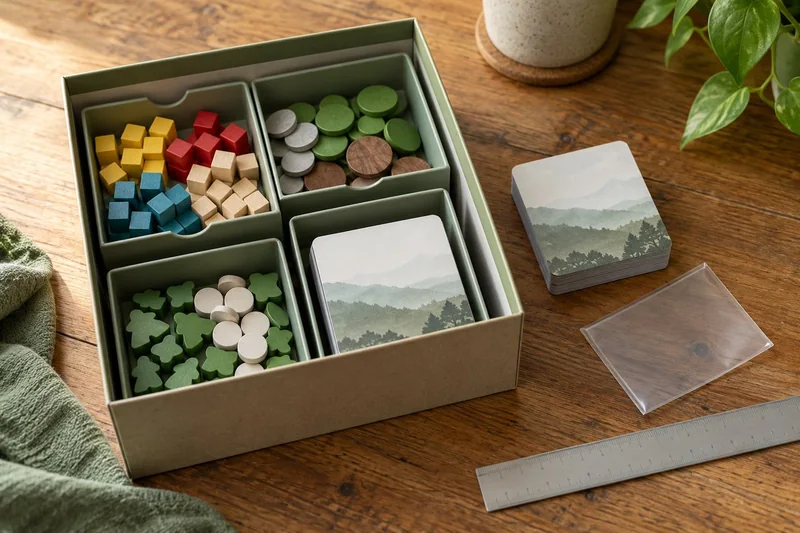
Ark Nova and Marine Worlds: when FS-ARNO is a sensible organizer choice
For standard components and sleeves within the maker’s stated specification, Folded Space FS-ARNO is a reasonable shortlist choice for Ark Nova plus…
Read the guide →