
Answer: Check the location’s stability, leak exposure and direct light before choosing containers. An enclosed box does not establish protection from a variable or damp environment.
BoardFit Atlas editorial project · Updated October 21, 2026 · Original decision framework and illustrative example. No physical product measurement or hands-on benchmark is claimed.
On this page: Why the distinction matters · A practical sequence · Decision record · Worked example · Verify the result · Question and answer · Sources and scope
Why the distinction matters
A garage or attic can have conditions that differ sharply from an occupied room. Assess the actual location over time rather than assuming that indoor-looking space is stable. Printed boards, cards, books, adhesives and plastic pieces may respond differently. General paper-preservation guidance helps identify hazards, but it does not provide a guaranteed storage specification for a mixed-material game.
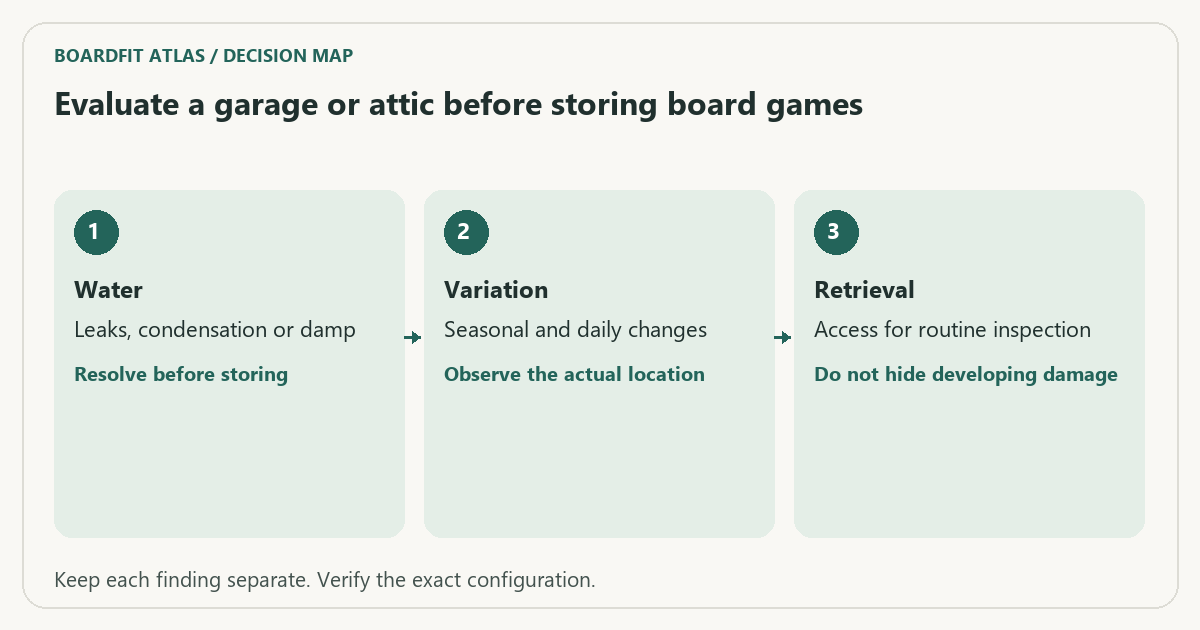
A practical sequence
- Inspect for roof or pipe leaks, direct sun, nearby heat sources and visible damp.
- Observe the location across relevant weather and heating changes using a dated log.
- Keep games supported away from known leak paths and avoid treating a sealed container as climate control.
- Choose a stable occupied indoor location when the alternative remains uncertain.
Decision record
| Check | What it means | What to verify |
|---|---|---|
| Water | Leaks, condensation or damp | Resolve before storing |
| Variation | Seasonal and daily changes | Observe the actual location |
| Retrieval | Access for routine inspection | Do not hide developing damage |
Worked example
An illustrative collection is moved to an attic in mild autumn weather. A single comfortable afternoon does not tell you what happens on a hot summer day or after a roof leak. The useful next action is a location assessment and a more stable temporary home, not a claim that a particular plastic bin solves every exposure.
Verify the result
Inspect stored components periodically and document changes. If material is wet, moldy or unusually valuable, obtain appropriate conservation advice before treatment. Do not use heat, chemical sprays or aggressive flattening based on a generic storage article.
Download the editable CSV worksheet · Box-fit workbook
Question and answer
Will a sealed bin prevent humidity problems? It may change exposure, but it does not remove moisture already inside or establish stable conditions. Evaluate the location and the materials together.
Sources and scope
- Library of Congress: care of works on paper — Supports careful handling and supportive storage. Does not certify commercial game materials.
The decision sequence, diagrams, worksheet and worked case are our editorial work. AI assisted research, drafting and implementation. Official references support the named technical distinctions; examples do not establish real product performance.
Continue the task
- Store board game rulebooks, maps and player aids without avoidable damage
- Check print-and-play card scale before cutting or sleeving
- Browse the complete resource library
Build on what you just learned
Your next useful step.
Leave space for retrieval, growth and a safe load.
Is the Wingspan Nesting Box worth the shelf space?
I would consider the Nesting Box for a Wingspan collection that is already spread across several frequently used boxes.
Read the guide →
Allow retrieval clearance around a tightly fitted game box
Measure the box in its packed state, then reserve space for your actual grip and removal path. Zero geometric clearance can leave a box…
Read the guide →