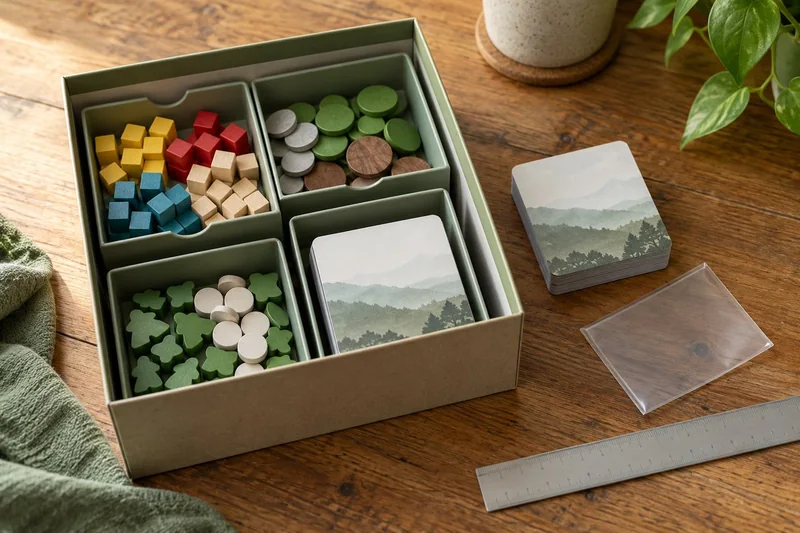
Short answer: Keep paper components supported, away from drinks and direct sunlight, and out of compartments that bend their corners. Match the enclosure to the actual sheet or booklet, not just the game box footprint.
Research guide · Sources checked October 18, 2026. The procedures and examples below are planning aids, not results from a hands-on product test.
On this page: Separate paper types before reorganizing · Give each item a supported place · Build a packing order you can repeat · Plan the shelf and the next game night
Separate paper types before reorganizing
Lay out the rulebook, loose reference sheets, folded maps and player aids. Record which items belong to the base game and which belong to an expansion. A campaign sheet with pencil notes needs a different retrieval plan from a rulebook you open every session. Keep the original folding pattern of a commercial map; do not add folds just to fit a new organizer.
The Library of Congress guidance for works on paper supports clean handling, keeping food and drink away, avoiding adhesive tape and rubber bands on paper, and using supportive protective enclosures. Those are general preservation principles. They do not certify the long-term behavior of every coated or laminated game component.
Give each item a supported place
| Component | Practical storage check | Avoid |
|---|---|---|
| Loose player aid | A supported slot or appropriately sized folder | Corners hanging below a heavy tray |
| Folded map | Original folds, supported face and available depth | New creases to fit a narrow compartment |
| Rule booklet | A flat area with clearance above the spine | Heavy point loads on the cover |
| Campaign notes | A separate labeled folder linked to the game | Writing on original components by mistake |
Measure the thickest bundle in its intended enclosure. Include the folder, map folds and booklet spine. A tray that clears a single sheet can still press on a folded map. For valuable paper items, choose enclosures with documented materials rather than assuming any clear plastic bag is an archival product.
Build a packing order you can repeat
- Empty the upper tray and inspect the paper area for sharp edges or loose pieces.
- Put the supported paper bundle in place without curling an edge.
- Add the remaining trays and boards in their intended order.
- Close the lid gently and look for pressure on paper edges.
- Take an owner reference photo and write down the order on a separate storage note.
Example: a rulebook and two expansion sheets fit under a board, but adding a folded map makes the board rock. Treat that as a failed arrangement. Move the map or change the tray order instead of pressing the lid shut. This example is a diagnostic scenario, not a test of a named insert.
Plan the shelf and the next game night
A folder stored outside the box should carry the game title, edition and expansion names. Add its location to the box inventory so an apparently complete box does not arrive at game night without its rules. If you consolidate expansions, use a consistent label rather than relying on memory.
Store the collection in a stable indoor location and check for leaks, strong light and nearby heat sources. Follow our humidity and location checklist for routine observation. If paper is wet, moldy, brittle or unusually valuable, seek appropriate conservation advice before attempting repairs. A storage guide cannot determine a safe treatment from a photograph.
Sources and scope
- Library of Congress: care of works on paper — General handling and enclosure guidance; not a material test of commercial board game components.
Continue with your next check
Build on what you just learned
Your next useful step.
Find components, rulebooks and the right expansion.
Wingspan Americas: update the storage plan before adding the new cards
Treat Americas as a mixed-component expansion, not simply another stack of bird cards.
Read the guide →
Wingspan Vision-Friendly Cards: replace the set without confusing the deck
If Wingspan’s card text is the obstacle, I would try the publisher’s Vision-Friendly cards before buying generic magnifiers or printing unofficial…
Read the guide →