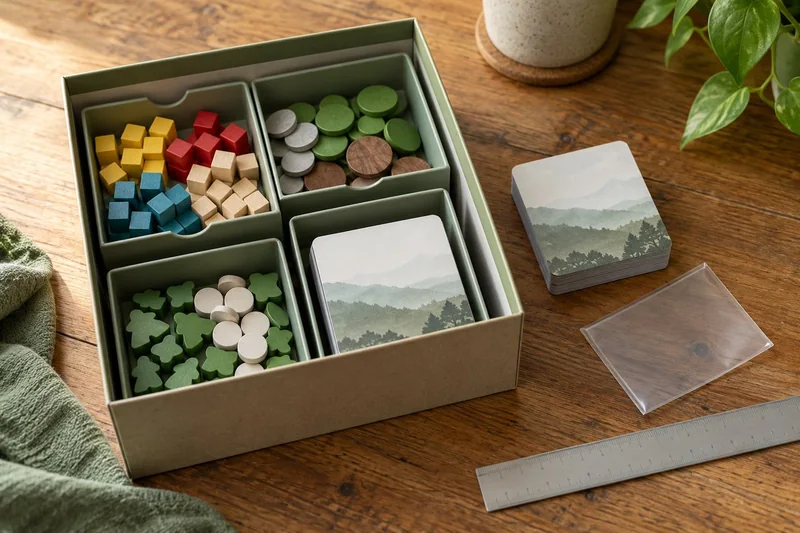
I would use a binder for browsing individual cards and a divided box for decks that move to the table in groups. A hybrid can work well: an active-play box plus an indexed archive. Do not choose by headline card capacity without deciding how cards will be found and returned.
On this page
Our recommendation
For a collection mainly played as complete decks, I prefer a divided box. For frequent individual-card selection, I would try a small binder section first and evaluate the return workload before buying several albums.
Browsing and deck handling are different tasks
A binder exposes several card faces at once and can make selection convenient. A divided box can keep a complete deck together and avoid moving many cards in and out of pockets. For games with frequent deckbuilding, consider the return task as well as the initial search.
Gamegenic’s Zip-Up Album 18-Pocket is listed with twenty pages and 360 side-loading pockets, with sleeve compatibility tied to the maker’s specification. That is a useful browsing-format candidate, not proof that every board-game card size or several cards per pocket are supported. Verify the exact format before buying.
Keep an index that survives changes
Choose a stable order such as expansion then card number, and reserve expansion space deliberately. If you use alphabetical order, consider how translated titles or future additions will affect the layout. Avoid reorganising the whole archive every time one pack arrives.
Record active decks as checked out from the archive. A missing pocket should have an understandable reason. For secret campaign material, use opaque, labelled storage rather than a binder that exposes unrevealed cards during browsing.
A hybrid arrangement
Keep the currently played deck in a labelled case and the unused collection in a numbered binder or divided box. The inventory entry says “active deck A removed from archive section 3”. When dismantling the deck, return cards against that list. This avoids treating an empty archive position as a lost card.
Before you act
- Test actual sleeve and card fit in a sample pocket.
- Reserve a clear place for future additions.
- Track cards temporarily removed into active decks.
Use the Box inventory template to apply the guide to your own setup.
Keep exploring
- Plan card divider height and readable tabs
- Board game component inventory: check missing pieces before game night
Sources and research notes
Research checked on 21 October 2026. Product specifications are manufacturer statements; examples and buying judgements are our analysis. No hands-on product test is implied.
Build on what you just learned
Your next useful step.
Choose sleeves, then check the complete deck.
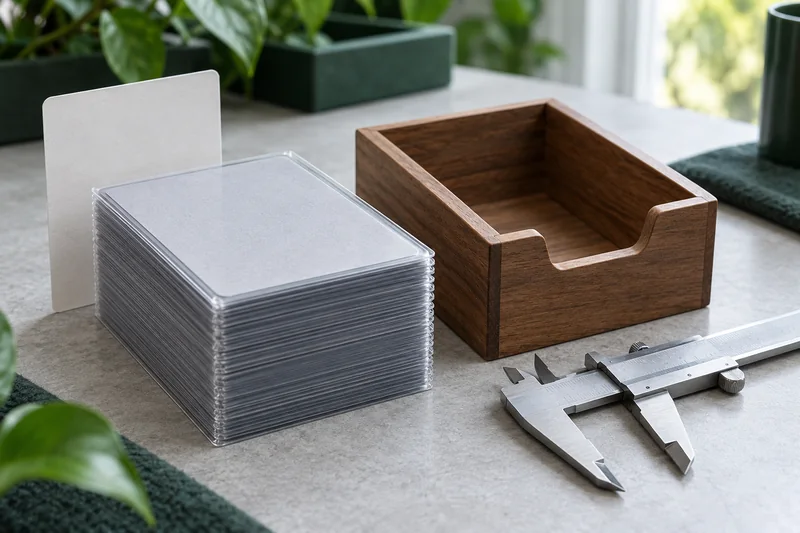
Boulder 100+ or Bastion 100+ XL for a board-game deck?
Choose a rigid deck case around the finished sleeved stack and the way you remove cards.
Read the guide →
Board game card sleeves: size, thickness, and storage
Short answer. Match the sleeve to the card, then check the sleeved card and the full deck against the storage space. Card fit and…
Read the guide →