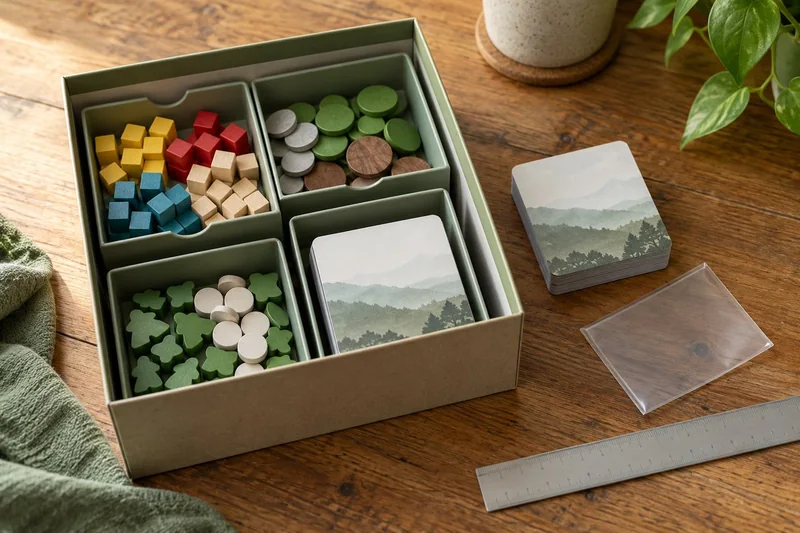
Short answer: Compare the contents with the component list for the exact edition and language you own. Count by component type, document discrepancies, and check the publisher or retailer policy for your region.
Research guide · Sources checked October 18, 2026. The procedures and examples below are planning aids, not results from a hands-on product test.
On this page: Identify the edition before counting · Use a discrepancy table · Resolve a discrepancy without mixing editions · Make the inventory useful after the first check
Identify the edition before counting
Write down the title, publisher, language, edition and any identifiable printing information from the box or rulebook. Include expansion names. A revised edition may change card counts or replace components, so a list copied from another owner can create a false missing-parts problem. Start with the rulebook included in your copy or an official matching rules download.
Separate punched waste, spare pieces, promotional additions and components used only by an expansion. Do not discard an unfamiliar token until you know what it is. If the official list groups pieces differently from the organizer, count against the official categories first and map them to trays afterward.
Use a discrepancy table
| Field | What to enter |
|---|---|
| Component | The name or category used in the matching rules |
| Expected | Official count and page or source |
| Found | Your count, including pieces outside the main box |
| Location | Tray, bag, expansion box or shelf folder |
| Status | Complete, recount needed or discrepancy documented |
Hypothetical example: the rules list 24 wooden markers; you find 20 in the main tray and four in a player pouch. The inventory is complete after you record both locations. Do not order replacements based on the first tray count. For a large deck, split it into counted groups on a clear surface and verify a second time before marking anything absent.
Resolve a discrepancy without mixing editions
- Check the play area, lid, bags and any consolidated expansion boxes.
- Recount in the same categories as the official component list.
- Compare the rulebook version and region with any downloaded list.
- Record the missing component names, expected counts and photos of what arrived.
- Check the official publisher and retailer process for the country of purchase.
Asmodee North America currently directs US customers with a newly purchased game that is missing or has damaged contents to the retailer where it was bought. That policy is a regional example, not a promise that every publisher sends spare parts. Keep the receipt and check the current policy before mailing components or paying for a replacement.
Make the inventory useful after the first check
Once a game is complete, record its storage locations in the box inventory. Add a short setup note for components stored elsewhere, such as a map folder or an expansion container. For games with evolving campaign contents, distinguish the original component inventory from the campaign state, so a deliberate change does not look like a loss.
Repeat a quick count of the small, easily misplaced pieces after travel or a crowded game night. The packing checklist can cover dice, tokens and accessory bags without repeating a full catalog every time. If you use a temporary substitute, make sure all players understand it and that it does not reveal hidden information or change the rules. A substitute is not proof that a missing original is unimportant.
Sources and scope
- Asmodee North America: customer support — US missing/damaged contents route; other publishers, regions and purchase conditions can differ.
Continue with your next check
Build on what you just learned
Your next useful step.
Find components, rulebooks and the right expansion.
Wingspan Americas: update the storage plan before adding the new cards
Treat Americas as a mixed-component expansion, not simply another stack of bird cards.
Read the guide →
Wingspan Vision-Friendly Cards: replace the set without confusing the deck
If Wingspan’s card text is the obstacle, I would try the publisher’s Vision-Friendly cards before buying generic magnifiers or printing unofficial…
Read the guide →