
Measure the unsleeved card first, then read what the sleeve label actually measures. A 66 × 91 mm sleeve is not a 66 × 91 mm card. A suitable sleeve can still make the deck too large for its original tray. Use the chart to shortlist a size, the pack calculation to buy the right quantity, and a measured sample to check the box.
On this page
Sleeve-size reference: one naming system, not a universal standard
These are Gamegenic Prime sleeve dimensions as listed by the manufacturer, not our measurements or the maximum card dimensions. Names and colour codes belong to this product range. Do not transfer them to another brand or assume that every edition of a named game uses the same cards.
| Prime format / code | Listed sleeve dimensions, mm |
|---|---|
| Mini American / Yellow | 44 × 67 |
| Mini European / Ruby | 46 × 71 |
| CATAN English / Red | 56 × 82 |
| Standard American / Green | 59 × 91 |
| Standard European / Purple | 62 × 94 |
| Standard Card Game / Gray | 66 × 91 |
| 7 Wonders / Brown | 67 × 103 |
| Scythe / Lost Cities / Magenta | 72 × 112 |
| Square / Blue | 73 × 73 |
| Big Square / Lime | 82 × 82 |
| Tarot / Orange | 73 × 122 |
| Dixit / Mysterium / Sand | 81 × 122 |
Open the manufacturer’s chart and select the candidate variation. For example, its Magenta variation lists 72 × 112 mm sleeves for cards up to 70 × 110 mm. That distinction explains why subtracting an arbitrary margin from every row would be unreliable.
Why two “standard” labels can show different numbers
Sleeve Kings SKS-8810 is labelled 63.5 × 88 mm, 60 microns and 110 per pack. Gamegenic’s Gray Prime variation lists 66 × 91 mm sleeve size. The different dimensions do not, by themselves, prove that these products serve different cards: the labels describe different things. Check the stated card fit and try the exact product. We have not physically compared these sleeves.
How many packs? Round each product separately
| Illustrative shopping list | Cards + spare sleeves | Pack size | Packs to buy | Unused sleeves |
|---|---|---|---|---|
| Format A | 143 + 7 = 150 | 100 | 2 | 50 |
| Format B | 51 + 4 = 55 | 50 | 2 | 45 |
| Total | 205 | Two different products | 4 | 95 |
For each exact product: packs = round up((cards + spares − matching sleeves already owned) ÷ pack size), never below zero. Do not add incompatible sizes together before rounding. Keep replacement cards that substitute for old cards separate from expansions that actually enlarge the active deck. Build a sleeve shopping list.
The box test: measure a stack, not just film thickness
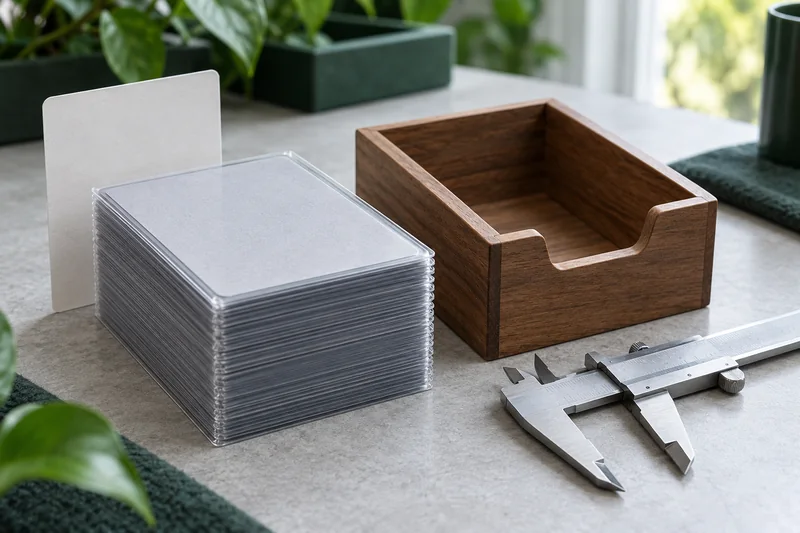
Sleeve 30–50 representative cards and let the stack settle normally. Measure the outside width, height and stack depth without squeezing. Include dividers in the compartment budget. Film thickness alone omits card stock, seams, texture and trapped air.
An illustrative 40-card sample measuring 18 mm gives 0.45 mm per sleeved card. At the same average, 150 cards need 67.5 mm before dividers. Two 1 mm dividers bring that to 69.5 mm; a 68 mm compartment fails this estimate by 1.5 mm. It is a proportional model, not a measured result for a product. Check the complete deck before treating it as a fit.
- Card bends or corners catch: stop and verify the intended card size; do not force it.
- A single sleeved card fits but the stack does not: check the compartment depth and dividers.
- The deck fits but cannot be removed: allow finger access or a removable tray.
- Only some sleeves differ: keep batches and product codes identifiable; a visibly different sleeve can reveal a hidden card.
Check usable box dimensions and orientations · Diagnose a blocked deck · Check printed card scale.
Sources and scope
The chart reports supplier specifications. Pack and stack examples are our arithmetic. No wear, shuffle or physical fit test is claimed. Reviewed November 19, 2026. Methods and corrections.
Build on what you just learned
Your next useful step.
Choose sleeves, then check the complete deck.
Boulder 100+ or Bastion 100+ XL for a board-game deck?
Choose a rigid deck case around the finished sleeved stack and the way you remove cards.
Read the guide →Dragon Shield Clear/Non-Glare: a useful option for bright game tables
For cards read repeatedly under overhead lighting, Dragon Shield’s current Clear/Non-Glare board-game line is worth a sample pack.
Read the guide →