
For cards read repeatedly under overhead lighting, Dragon Shield’s current Clear/Non-Glare board-game line is worth a sample pack. I would test the non-glare face toward the readable card front first. For double-sided artwork or fine detail, compare both orientations before committing to the whole game.
On this page
Our recommendation
I would choose this line for a demonstrated reflection problem, rather than buying premium sleeves on a vague promise of “better protection”. No shuffle-feel or seam-strength test is claimed here.
Identify the current product
The Common Standard AT-60205 listing describes 100 sleeves, 100-micron polypropylene, for cards up to 63 × 88 mm. One face is clear and the other non-glare. This matters because older products and trading-card “Matte” sleeves can have different pack counts, thicknesses or surface treatments. Use the exact product number when comparing a shop listing.
The publisher’s example-game list helps you find a candidate size; it does not prove every card type in every expansion will fit. Measure a few cards from each format and compare the manufacturer’s card-size limit. Keep reference cards and mini cards separate in your shopping list.
A glare test that costs one pack
Place the same card unsleeved, clear-side-forward and non-glare-side-forward under your normal light. Read it from the seats actually used at game night, rather than only from directly above. Check small text, dark icons and the view across the table. Move the lamp or card angle too: a sleeve cannot remove every reflection in every direction.
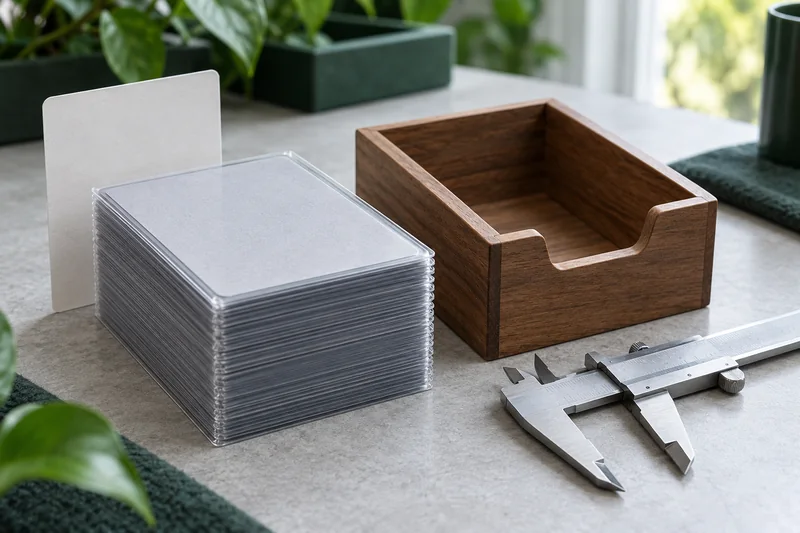
Then shuffle a short sample deck and leave it in a stack for a while before measuring. Evaluate readability and storage together. A finish you prefer visually can still make the old insert unusable once the whole deck is protected. Avoid replacing hundreds of sleeves until both tests work.
Make the choice reproducible
Use ten representative cards: a dark illustration, a pale card, small print and at least one card read from the opposite side of the table. Note the light position and chosen orientation. If the deck has information on both faces, turn it over as part of the test; solving glare on one side may change the other side’s appearance.
Before you act
- Verify AT-60205 rather than an older similarly named pack.
- Test both faces under the actual room lighting.
- Recheck the complete deck’s storage space.
Use the Sleeve Pack Planner to apply the guide to your own setup.
Keep exploring
Sources and research notes
Research checked on 21 October 2026. Product specifications are manufacturer statements; examples and buying judgements are our analysis. No hands-on product test is implied.
Build on what you just learned
Your next useful step.
Choose sleeves, then check the complete deck.
Boulder 100+ or Bastion 100+ XL for a board-game deck?
Choose a rigid deck case around the finished sleeved stack and the way you remove cards.
Read the guide →Board game card sleeves: size, thickness, and storage
Short answer. Match the sleeve to the card, then check the sleeved card and the full deck against the storage space. Card fit and…
Read the guide →