Compare all six box orientations and keep the measurements, allowance and results in a downloadable local record. This is a geometric planning tool; it does not establish furniture load capacity or product compatibility.
How to use the result
Measure the packed box and the narrowest usable opening in the same units. Include the lid in its real position. Enter a minimum total spare dimension for each axis; the form uses the same allowance on width, depth and height. A zero allowance can report contact as a geometric fit, so choose and verify a practical retrieval allowance.
Worked reference case
For a 300 × 300 × 80 mm packed box and a 350 × 350 × 120 mm space with 5 mm total allowance, the two permutations with 80 mm as height pass. Their spare dimensions are 50, 50 and 40 mm. The other four permutations put a 300 mm dimension into the 120 mm height and fail. The duplicate passes are intentionally retained so every axis mapping remains visible.
Formula and boundaries
For each orientation, spare axis = available axis − required box axis. A permutation passes only when all three spare values are at least the chosen allowance. The six mappings are width/depth/height, width/height/depth, depth/width/height, depth/height/width, height/width/depth and height/depth/width.
The calculation treats the opening and box as rectangular envelopes. It does not model a curved entry, hinges, compressible packing, lifting strength, shelf loading or containment after rotation. A pass is a prompt for a supported real-world check. A result based on an unmeasured dimension remains an estimate.
Keep and review the record
Calculate a valid result before downloading JSON or CSV. Downloads contain the current calculated inputs, configuration notes and results. If you edit inputs after calculating, calculate again before saving. The record is a decision aid, not a certificate. Do not put passwords, private addresses or unrelated personal data into the notes.
Verification and evidence
The workbook arithmetic is checked with reference and invalid-input cases in the release source. These are software checks, not physical product tests or a measurement of encoder quality. AI assisted drafting and implementation. The original formulas, constraints and worked examples are visible here so a reader can audit the result.
Continue with a specific guide
Browse all guides and editable worksheets · Published library update record
Build on what you just learned
Your next useful step.
Choose trays around the way you actually play.

Token Silo or Token Silo XL? Choose the tray layout before the bigger box
I would choose the original Token Silo for a modest shared supply of small tokens, and the XL when long components or several card…
Read the guide →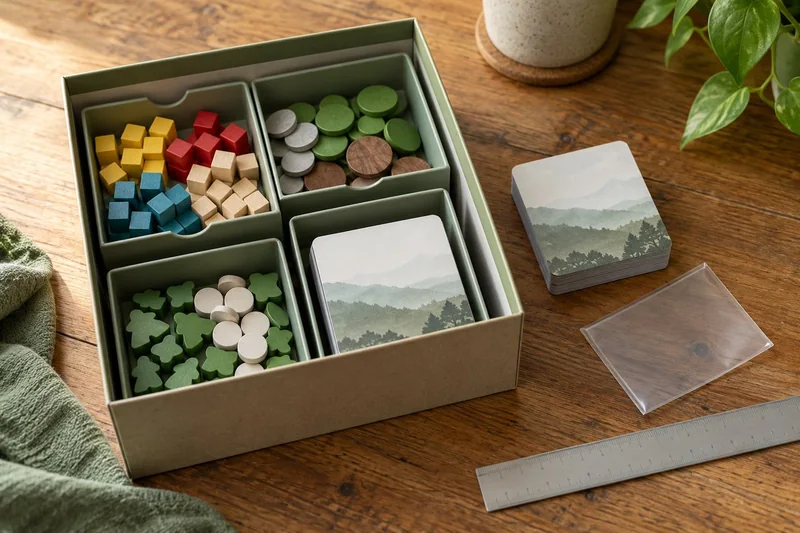
Ark Nova and Marine Worlds: when FS-ARNO is a sensible organizer choice
For standard components and sleeves within the maker’s stated specification, Folded Space FS-ARNO is a reasonable shortlist choice for Ark Nova plus…
Read the guide →