
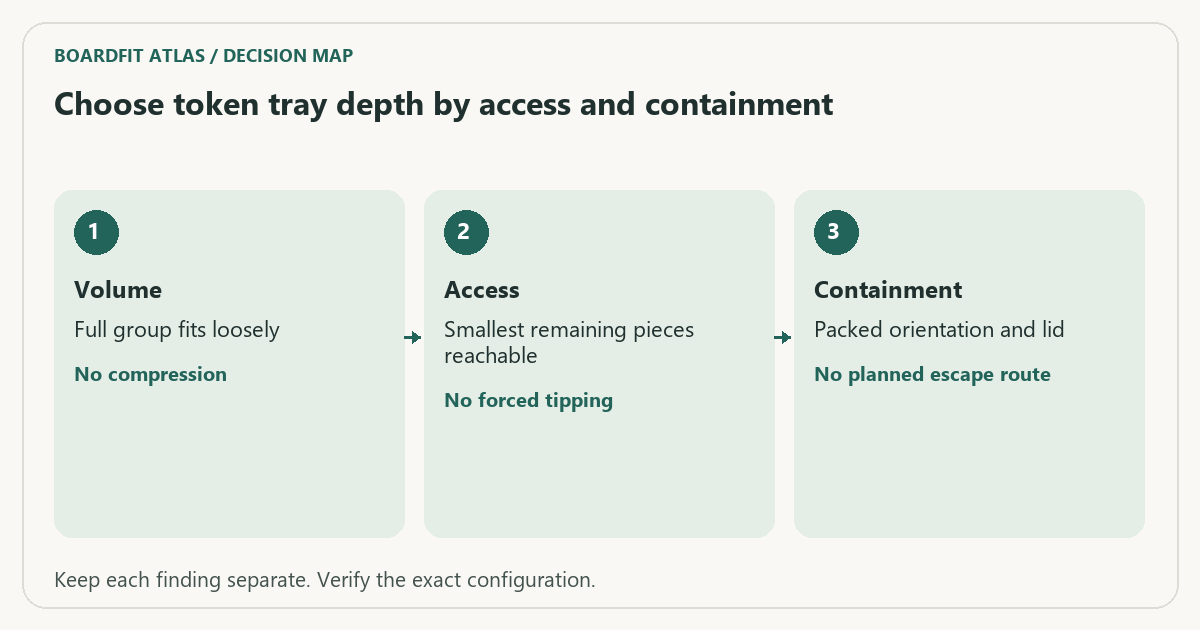
Answer: A tray must hold the full token group and let players retrieve it comfortably. Check opening width, usable depth, rounded corners and whether a lid is needed during storage.
Our practical pick: shallow, removable trays
For frequently shared wooden cubes and tokens, we would choose a shallow removable tray over a deep fixed compartment. Players can reach the pieces, and the tray can move directly from the box to the table. We would use a lidded container instead when travel containment is the priority, and separate foam compartments for fragile miniatures.
We would not buy a custom organizer until ordinary bags or trays have failed a specific task. Compare the bags-versus-trays workflow, then record the actual well dimensions in the fit workbook.
BoardFit Atlas editorial project · Updated October 21, 2026 · Original decision framework and illustrative example. No physical product measurement or hands-on benchmark is claimed.
On this page: Why the distinction matters · A practical sequence · Decision record · Worked example · Verify the result · Question and answer · Sources and scope
Why the distinction matters
Multiplying outer dimensions gives neither usable capacity nor ease of use. Thick walls, curved corners and a raised base all reduce the interior. A deep, narrow tray may contain everything but make the last token difficult to reach. A shallow tray may work on the table and spill during carrying. Decide whether it is a play tray, a storage container or both, and evaluate those tasks separately.
A practical sequence
- Group the complete common supply, including the expansion configuration you intend to use.
- Trial a reversible container on the table and check access to the last few pieces.
- Inspect its lid or containment plan with the packed game supported.
- Check that a player can identify and return every token group at teardown.
Decision record
| Check | What it means | What to verify |
|---|---|---|
| Volume | Full group fits loosely | No compression |
| Access | Smallest remaining pieces reachable | No forced tipping |
| Containment | Packed orientation and lid | No planned escape route |
Worked example
An illustrative 80 × 60 × 30 mm outer tray has 3 mm walls and base. A simple rectangular interior estimate is 74 × 54 × 27 mm, about 108 mL rather than the 144 mL outer volume. Rounded corners reduce it further. These calculations are geometric estimates; the loose token group still needs a physical trial.
Verify the result
Use the smallest practical number of trays that preserves the game’s setup groups. Record whether a tray is emptied on the table or used directly during play. Recheck the arrangement if a lid is removed to gain clearance.
Download the editable CSV worksheet · Box-fit workbook
Question and answer
Does enough calculated volume prove tokens will fit? No. Shapes leave voids and may bridge across a narrow opening. Trial the actual group without pressure.
Sources and scope
- Folded Space: Tapestry insert — An example of configuration-specific packing information, not universal insert compatibility.
The decision sequence, diagrams, worksheet and worked case are our editorial work. AI assisted research, drafting and implementation. Official references support the named technical distinctions; examples do not establish real product performance.
Continue the task
- Store a game without its original insert
- Measure miniature storage around the tallest fragile point
- Browse the complete resource library
Build on what you just learned
Your next useful step.
Choose trays around the way you actually play.
Token Silo or Token Silo XL? Choose the tray layout before the bigger box
I would choose the original Token Silo for a modest shared supply of small tokens, and the XL when long components or several card…
Read the guide →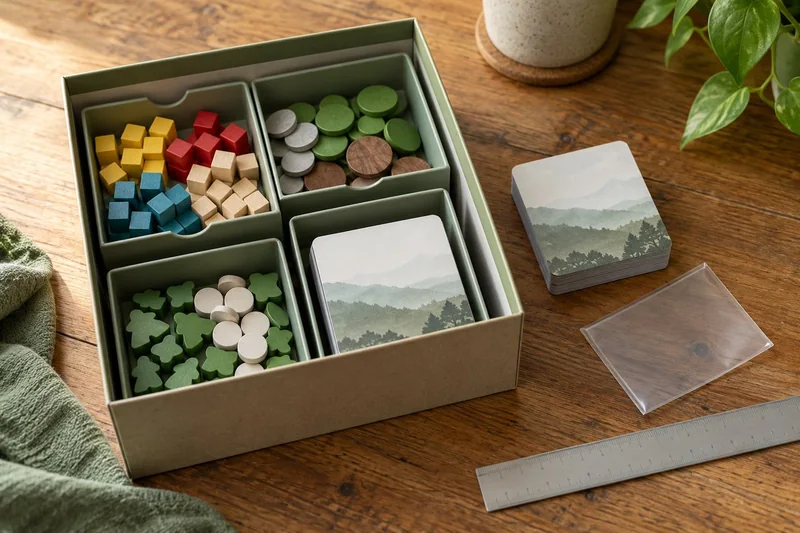
Ark Nova and Marine Worlds: when FS-ARNO is a sensible organizer choice
For standard components and sleeves within the maker’s stated specification, Folded Space FS-ARNO is a reasonable shortlist choice for Ark Nova plus…
Read the guide →