
Answer: Use the miniature’s full resting envelope, including protruding weapons and its base. A compartment that accepts the base can still press on a fragile top or side detail.
BoardFit Atlas editorial project · Updated October 21, 2026 · Original decision framework and illustrative example. No physical product measurement or hands-on benchmark is claimed.
On this page: Why the distinction matters · A practical sequence · Decision record · Worked example · Verify the result · Question and answer · Sources and scope
Why the distinction matters
The useful clearance is the space around the actual stored pose, not the nominal scale printed on the game. Separate contact points meant to support the base from protrusions that should remain free. Painted pieces may require a different handling decision from unpainted components. A generic organizer listing cannot establish that a modified miniature or decorative base will fit. Keep the existing protective packaging until the alternative is verified.
A practical sequence
- Identify the largest width, depth and height in the intended resting position without flexing the piece.
- Check the compartment opening and the lid above it, including any stacked boards.
- Trial one miniature at a time with the tray supported and stop at the first contact with a fragile part.
- Document the approved position and identify pieces requiring separate protection.
Decision record
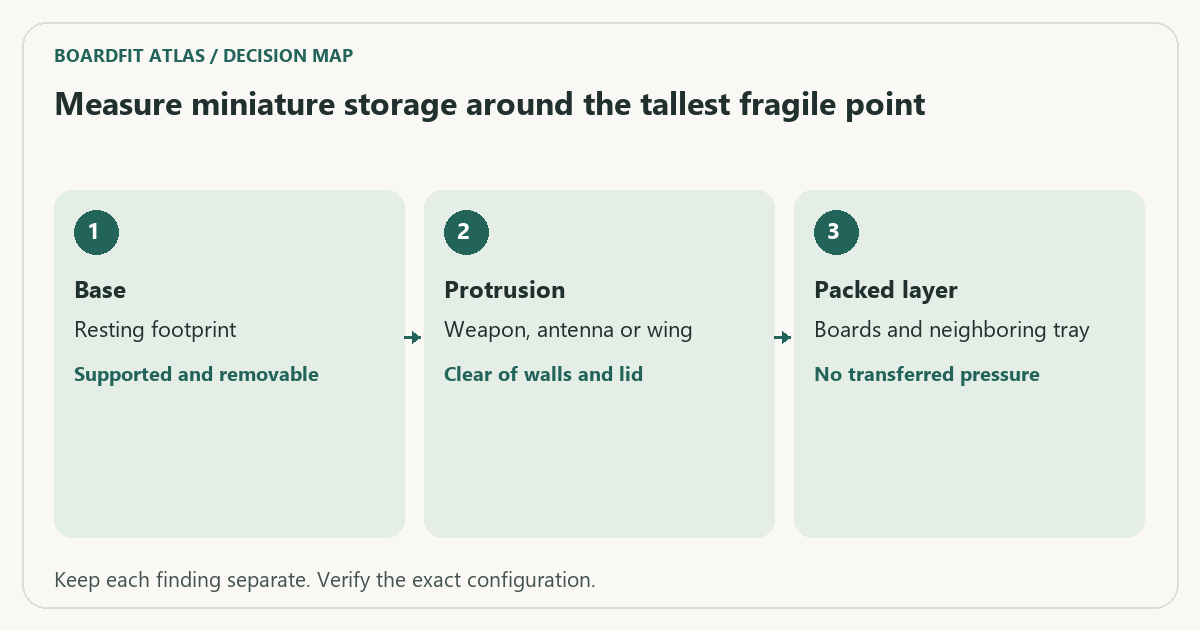
| Check | What it means | What to verify |
|---|---|---|
| Base | Resting footprint | Supported and removable |
| Protrusion | Weapon, antenna or wing | Clear of walls and lid |
| Packed layer | Boards and neighboring tray | No transferred pressure |
Worked example
A fictional miniature is 42 mm tall at the head but 57 mm at a raised spear. A tray with 50 mm clear height fails the spear even though its advertised figure height might sound suitable. Tilting the piece introduces a new width and support question; it should not be assumed to solve the fit.
Verify the result
Photograph the safe packing position for your own reference. Avoid trial shaking or dropping a loaded box to see whether a piece survives. If containment is uncertain, keep that configuration unresolved and use the established packaging.
Download the editable CSV worksheet · Box-fit workbook
Question and answer
Can I infer clearance from a tray’s outer height? No. Base thickness, lid geometry and stacked layers reduce usable height. Measure the actual space above the resting point.
Sources and scope
- Folded Space: Tapestry insert — An example of configuration-specific packing information, not universal insert compatibility.
The decision sequence, diagrams, worksheet and worked case are our editorial work. AI assisted research, drafting and implementation. Official references support the named technical distinctions; examples do not establish real product performance.
Continue the task
- Board game inserts: evaluate fit before features
- Check a 3D-printed board game insert before printing the full set
- Browse the complete resource library
Build on what you just learned
Your next useful step.
Choose trays around the way you actually play.

Token Silo or Token Silo XL? Choose the tray layout before the bigger box
I would choose the original Token Silo for a modest shared supply of small tokens, and the XL when long components or several card…
Read the guide →
Ark Nova and Marine Worlds: when FS-ARNO is a sensible organizer choice
For standard components and sleeves within the maker’s stated specification, Folded Space FS-ARNO is a reasonable shortlist choice for Ark Nova plus…
Read the guide →