A storage purchase should solve a specific problem: finding games, closing boxes safely, fitting shelves or packing for travel. Use this checklist to build a short record before buying organizers. It is a planning worksheet; it does not establish compatibility with a named product.
1. Record what you own
Create one entry per game edition. Include language, expansions, paper components stored elsewhere and any existing missing-parts questions. Record where the game lives now and whether it is played often. Use the box inventory and save your own copy of the records. A title alone cannot distinguish two editions with different components.
2. Measure the limiting space
Measure the usable interior of the box and the actual shelf depth, including obstructions and retrieval space. Work in a consistent unit. Record the complete sleeved deck rather than estimating from card count alone. Our box measurement guide explains what to include; the shelf calculator helps compare your own dimensions.
| Question | Evidence to keep |
|---|---|
| Does the box close without pressure? | Owner measurements and packing order |
| Do components stay separated? | Tray/container arrangement and orientation |
| Can you retrieve the game safely? | Shelf location and accessible clearance |
| Are rules and expansions findable? | Inventory locations and labels |
| Will a sleeve change fit? | Exact sleeve products and actual stack measurements |
3. Choose one improvement at a time
Start with the most frequent frustration. Labeling a consolidated expansion may solve a retrieval problem without replacing an insert. A separate deck box may solve a tall stack without modifying the game box. Read double sleeve fit checks before changing two variables at once. Keep a reversible arrangement until you have checked it with every component in place.
4. Protect paper and small pieces
Keep rulebooks, player aids and maps supported and out of tight corners. Confirm small container closures before choosing vertical storage. The paper component guide links general preservation principles from the Library of Congress and explains their limits. Document a component inventory against the correct edition before treating an unfamiliar part as a spare.
5. Save a move-ready record
Write down carton IDs, split expansion locations and the final packing order. Use the packing checklist for a trip and the collection moving plan for a household move. Keep an accessible copy of important records outside the packed boxes. Recheck the layout whenever you add sleeves, an expansion or a new tray.
How to use a worked example
Suppose the current problem is a lid that lifts after an expansion is added. First inventory the added pieces, then measure the tallest completed stack and confirm the packing order. Only then compare alternate storage. A larger advertised organizer capacity alone does not show that your particular edition, sleeves and boards fit.
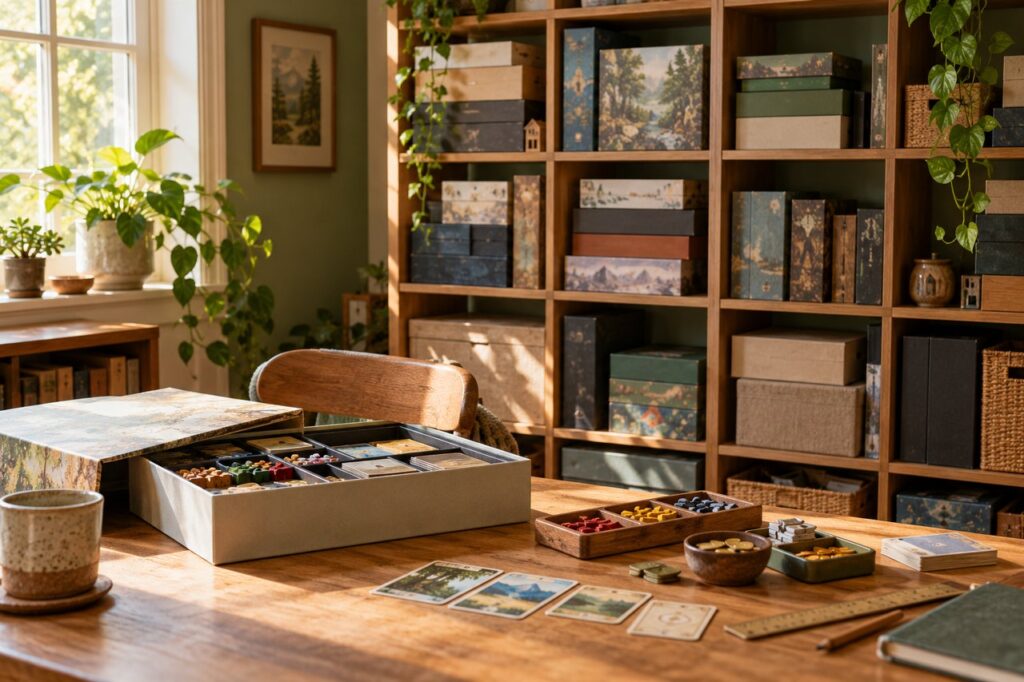
This checklist combines our storage workflows. For source handling, measurement limits and the distinction between research and physical testing, see our methodology. Illustrations show representative arrangements and do not document tested product compatibility.