
Answer: Keep confirmed dimensions separate from a planning reserve. An unknown future expansion should remain an unknown rather than a promise that spare volume will hold it.
BoardFit Atlas editorial project · Updated October 21, 2026 · Original decision framework and illustrative example. No physical product measurement or hands-on benchmark is claimed.
On this page: Why the distinction matters · A practical sequence · Decision record · Worked example · Verify the result · Question and answer · Sources and scope
Why the distinction matters
A reserve is useful for deciding how tightly to consolidate a collection. It becomes misleading when expressed as “room for two expansions” without knowing their components. Cards, boards and miniatures consume different spaces, and loose empty volume may be unusable for a rigid board. Start with one documented current configuration, then state the reserve as a dimension or named empty compartment rather than an unsupported product count.
A practical sequence
- Record the current loaded arrangement and every confirmed expansion.
- Identify which channels are genuinely unused after cards, dividers and boards are packed.
- State the remaining width, length or height in the relevant compartment.
- Recheck when an announced expansion has a reliable component list and dimensions.
Decision record
| Check | What it means | What to verify |
|---|---|---|
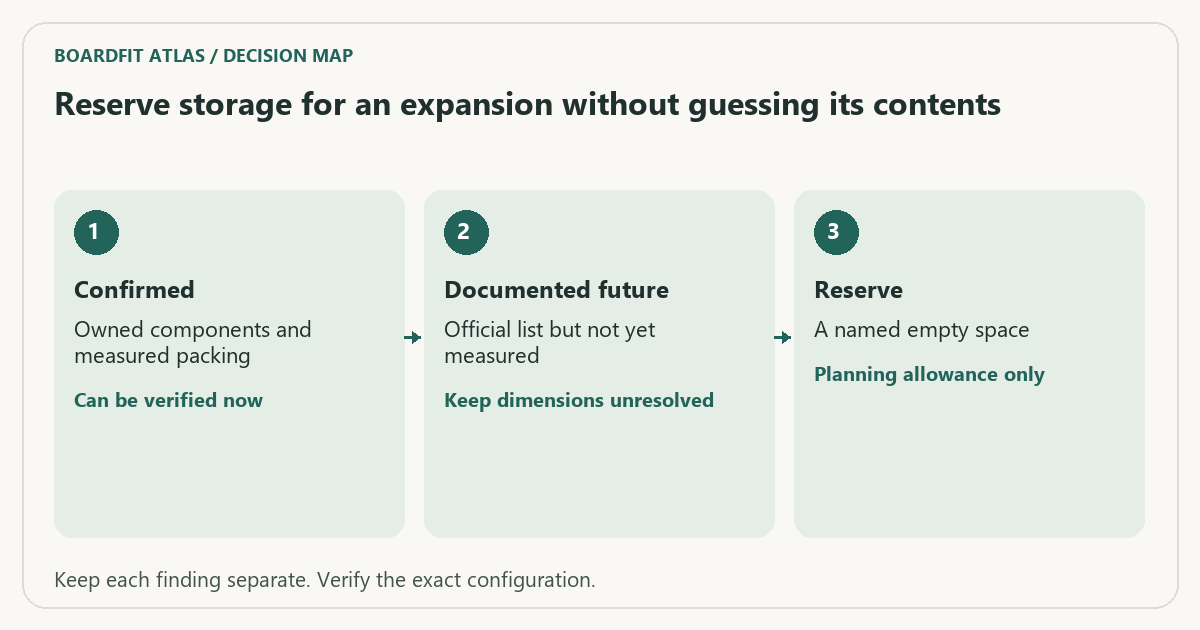
| Confirmed | Owned components and measured packing | Can be verified now |
| Documented future | Official list but not yet measured | Keep dimensions unresolved |
| Reserve | A named empty space | Planning allowance only |
Worked example
A fictional insert leaves 25 mm of unused card-channel length and no spare board height. A future deck may fit that channel, but a new rigid board may not fit the closed box at all. Calling the configuration “expansion ready” would conceal the limiting height. Record both constraints.
Verify the result
Retain the original expansion box while the consolidated arrangement is under evaluation. Keep the no-force lid check as the final step. Use separate storage when the new configuration cannot close comfortably rather than making an empty-space promise work by compression.
Download the editable CSV worksheet · Box-fit workbook
Question and answer
Is a percentage of unused box volume a useful reserve? It can summarize space, but include the shape and location. Twenty percent in disconnected narrow gaps may be unusable for a large component.
Sources and scope
- Folded Space: Tapestry insert — An example of configuration-specific packing information, not universal insert compatibility.
The decision sequence, diagrams, worksheet and worked case are our editorial work. AI assisted research, drafting and implementation. Official references support the named technical distinctions; examples do not establish real product performance.
Continue the task
- Lid lift: diagnose an insert that raises the box lid
- Lend a board game with a clear return record
- Browse the complete resource library
Build on what you just learned
Your next useful step.
Choose trays around the way you actually play.
Token Silo or Token Silo XL? Choose the tray layout before the bigger box
I would choose the original Token Silo for a modest shared supply of small tokens, and the XL when long components or several card…
Read the guide →
Ark Nova and Marine Worlds: when FS-ARNO is a sensible organizer choice
For standard components and sleeves within the maker’s stated specification, Folded Space FS-ARNO is a reasonable shortlist choice for Ark Nova plus…
Read the guide →