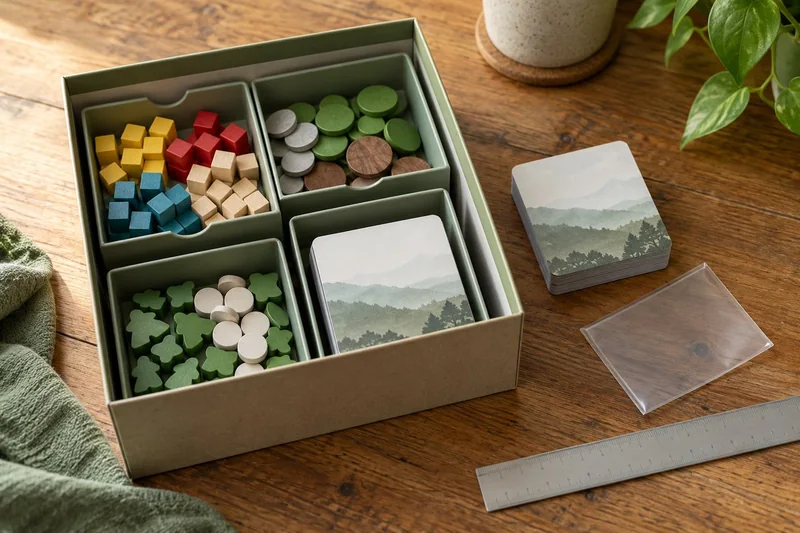
For a blind draw, the bag must conceal the contents and allow the required pieces to mix and be retrieved without identifying them unintentionally. I would test opacity, opening access and the actual token set before replacing the supplied bag. A larger decorative pouch is not automatically a better game component.
On this page
Our recommendation
I would keep the supplied bag when it works. Replace it to solve a demonstrated access, capacity or concealment issue, and evaluate the actual token pool rather than a handful of convenient samples.
Check what must remain unknown
Read the game’s draw procedure and identify whether pieces are meant to be distinguishable by touch. Some games deliberately use tactile differences; others rely on tokens being indistinguishable until revealed. A replacement container should preserve that intended information rather than applying a generic rule.
Hold the empty and filled bag under the room’s actual lighting. Check whether silhouettes, printed faces or colours can be seen through the material or opening. Consider what the drawing player can see while reaching in, not only what an observer sees from across the table.
Test the complete set
Load the required token pool and follow the normal mixing procedure. Check for pieces that lodge in corners, cling to a lining or cannot pass comfortably through the opening. A hand should be able to retrieve a piece in the intended way without forcing it against a seam.
Keep the original bag until the substitute has been used successfully and the group agrees it preserves the game. Record the replacement in the inventory. Do not claim that a short home trial proves statistical randomness; it can reveal practical access and concealment problems, not certify every draw distribution.
A practical access test
Use the smallest and largest token shapes from the actual pool, with all required pieces loaded. Mix, draw and return them several times while another player watches for visibility and snagging. If one shape repeatedly remains in a tight corner, change the container or mixing method in a way consistent with the rules rather than ignoring the problem.
Before you act
- Preserve the rules’ intended tactile information.
- Test opacity during a real reach.
- Check corners and seams with the full pool.
Use the Fit workbook to apply the guide to your own setup.
Keep exploring
- Choose component bags and trays by the usable space
- Board game component inventory: check missing pieces before game night
Method note: this is an original planning procedure with illustrative inputs. It does not report a physical product test. Check the exact product, edition and official instructions before acting.
Build on what you just learned
Your next useful step.
Choose trays around the way you actually play.

Token Silo or Token Silo XL? Choose the tray layout before the bigger box
I would choose the original Token Silo for a modest shared supply of small tokens, and the XL when long components or several card…
Read the guide →Ark Nova and Marine Worlds: when FS-ARNO is a sensible organizer choice
For standard components and sleeves within the maker’s stated specification, Folded Space FS-ARNO is a reasonable shortlist choice for Ark Nova plus…
Read the guide →