
Pair colour with a second visible distinction, such as shape, a readable label or a clearly separated compartment. I would start with a player-approved reference aid and reversible storage labels. Changing the physical pieces is worthwhile only if everyone can still identify the intended game state consistently.
On this page
Our recommendation
I favour simple, reversible dual coding before expensive replacement sets. When the board itself remains inaccessible, choose a different game or an agreed adaptation rather than treating storage labels as a complete solution.
Find the decisions that depend on colour
Walk through setup and a representative turn. Note every moment when a player must distinguish resources, ownership, routes or status markers. The difficult distinction may be between pieces on the board rather than pieces in the tray. Sorting the box perfectly will not solve a colour-only map or an ambiguous player marker.
Ask the affected player which distinctions are difficult under the room’s actual lighting. Avoid assuming that one colour combination or one label system solves the problem for everyone. A phone filter can help a designer inspect a layout, but it is not a substitute for the person’s own assessment.
Make a reversible second code
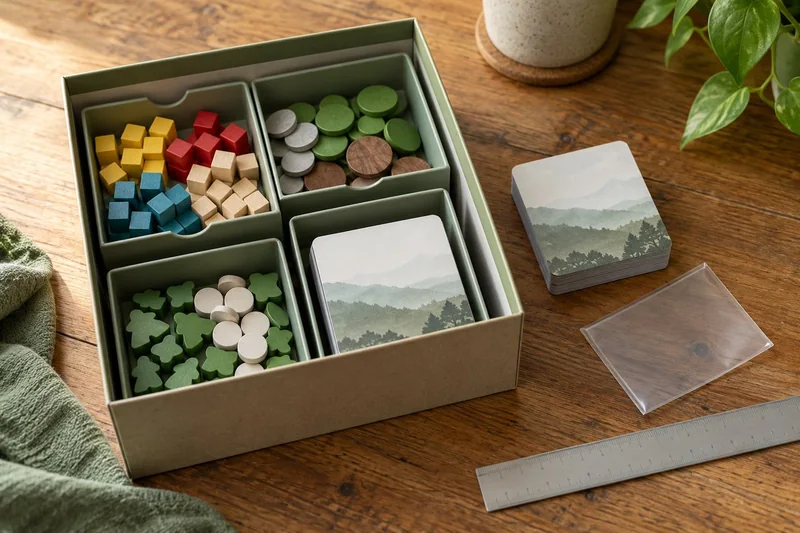
Use labelled compartments for shared supplies and a small player reference that pairs each colour with its meaning. For ownership, a distinct marker shape may work better than a label attached to every piece. Check that replacement shapes still sit clearly in the board spaces and do not hide information.
Keep the original pieces and document every substitution. Do not mark a hidden card back or add tactile information to one secret component unless the game and group intentionally allow it. An adaptation should not accidentally disclose information or change the probability of a blind draw.
A four-player ownership check
Assign each player a shape as well as a colour, then place the markers in a crowded part of the board. Ask everyone to identify ownership from their own seat. If two shapes are indistinguishable at that distance, revise the system before the game starts. Store the matching player reference in the same kit as the markers.
Before you act
- Test the active board, not only the sorted supply.
- Keep hidden information hidden.
- Record substitutions and retain the originals.
Use the Box inventory template to apply the guide to your own setup.
Keep exploring
- Board game component inventory: check missing pieces before game night
- Build complete player kits without hiding shared components
Sources and research notes
Research checked on 21 October 2026. Product specifications are manufacturer statements; examples and buying judgements are our analysis. No hands-on product test is implied.
Build on what you just learned
Your next useful step.
Find components, rulebooks and the right expansion.
Wingspan Americas: update the storage plan before adding the new cards
Treat Americas as a mixed-component expansion, not simply another stack of bird cards.
Read the guide →Wingspan Vision-Friendly Cards: replace the set without confusing the deck
If Wingspan’s card text is the obstacle, I would try the publisher’s Vision-Friendly cards before buying generic magnifiers or printing unofficial…
Read the guide →