
I would choose the original Token Silo for a modest shared supply of small tokens, and the XL when long components or several card formats genuinely need their own removable trays. Buying the XL simply because it has more compartments can leave a small table with a larger storage problem.
On this page
Our recommendation
My default is the original for small shared pools; choose XL for a demonstrated long-piece or mixed-format need. This is a specification-based recommendation, not a hands-on durability verdict.
The useful difference is the footprint
Gamegenic lists the original at 212 × 166 × 32 mm with nine removable trays in three sizes. The XL is 312 × 212 × 32 mm and has fifteen trays in five sizes, including a long tray. These are manufacturer dimensions, not our measurements. Neither outline describes the free area needed when every tray is spread across the table.
Draw both rectangles on scrap paper. Put your actual coin, resource and status-marker piles inside them. Then move the piles toward the players who use them. If the long tray solves no identifiable component problem, the smaller model is the more defensible starting point.
Choose compartments by the refill task
A tray that holds all the coins is not automatically the best coin supply. In a four-player game, two small dishes on opposite sides may avoid repeated reaching. Conversely, dividing a resource that is frequently exchanged into tiny compartments can create needless refilling. Decide whether you want storage, serving dishes, or both before counting compartments.
For tall or unusually shaped pieces, make a simple depth gauge from folded card. Check that the tallest item clears the lid without pressure. Avoid assuming that shallow trays will contain loose pieces during a vertical journey just because they work well on a flat table.
A practical mock-up
Suppose your game needs six token types and one card deck. Make six paper compartments, fill them and play one turn. If two piles run empty while four remain almost unused, rearrange the supply before buying. If the original-sized outline already crowds the player boards, an XL will not fix access; use several small removable dishes and keep the transport container off the table.
Before you act
- Measure the space beside the player boards, not only the cupboard.
- Check the internal dimensions of the specific tray that will hold the largest piece.
- Test a closed container with inexpensive stand-in components before travelling.
Use the Fit workbook to apply the guide to your own setup.
Keep exploring
Sources and research notes
Research checked on 21 October 2026. Product specifications are manufacturer statements; examples and buying judgements are our analysis. No hands-on product test is implied.
Build on what you just learned
Your next useful step.
Choose trays around the way you actually play.
Bags or removable trays? Choose by the setup task
Use bags when flexible grouping matters and trays when the same group needs to reach the table ready to use. Compare sorting, table space…
Read the guide →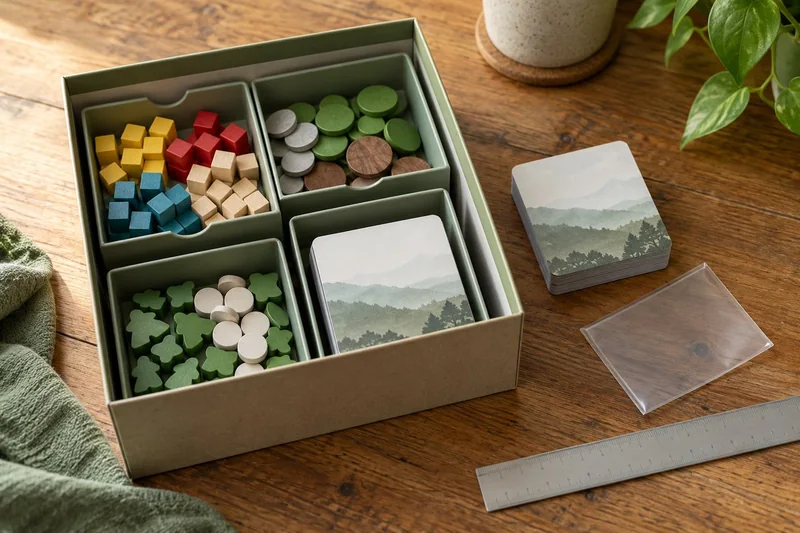
Ark Nova and Marine Worlds: when FS-ARNO is a sensible organizer choice
For standard components and sleeves within the maker’s stated specification, Folded Space FS-ARNO is a reasonable shortlist choice for Ark Nova plus…
Read the guide →