
Answer: Choose games by the available table, session plan and manageable carrying load. Pack the complete play configuration and a return checklist before optimizing how many boxes enter the bag.
BoardFit Atlas editorial project · Updated October 21, 2026 · Original decision framework and illustrative example. No physical product measurement or hands-on benchmark is claimed.
On this page: Why the distinction matters · A practical sequence · Decision record · Worked example · Verify the result · Question and answer · Sources and scope
Why the distinction matters
A bag can hold more games than one evening can use. Start with player count, likely duration, table space and any accessibility needs the group has agreed to accommodate. Record components stored outside their main boxes, including mats and reference folders. The return trip often happens in a hurry, so make the teardown plan visible before leaving home.
A practical sequence
- Select a primary game and a realistic fallback for the group and time available.
- Check the table footprint using actual boards, player areas and common supplies.
- Pack the corresponding editions, expansions and separate accessories, then weigh the load.
- Use a brief return check at the venue before closing bags and leaving.
Decision record
| Check | What it means | What to verify |
|---|---|---|
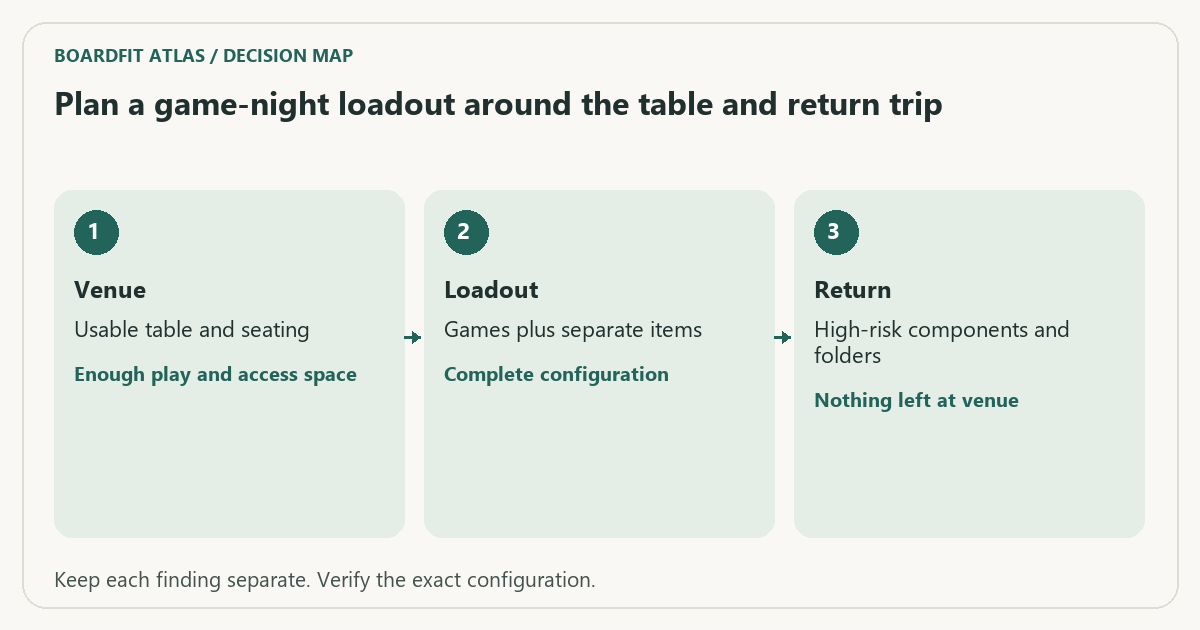
| Venue | Usable table and seating | Enough play and access space |
| Loadout | Games plus separate items | Complete configuration |
| Return | High-risk components and folders | Nothing left at venue |
Worked example
An illustrative bag holds three large boxes, but only one game’s board and player areas fit the venue table. Carrying all three adds weight without adding a usable choice. A smaller fallback that fits the table can be a better addition than another large box. This is a planning comparison, not a measured bag-capacity test.
Verify the result
Keep drinks and unrelated heavy objects separated from paper components. Support boxes while extracting them and avoid pulling on lids. Update the loadout after a venue or player-count change instead of reusing a packing list blindly.
Download the editable CSV worksheet · Box-fit workbook
Question and answer
Should I fill unused bag space with another game? Only if it is a useful option and the complete load remains manageable within the bag’s instructions. Empty space can simplify retrieval.
Sources and scope
- Folded Space: Tapestry insert — An example of configuration-specific packing information, not universal insert compatibility.
The decision sequence, diagrams, worksheet and worked case are our editorial work. AI assisted research, drafting and implementation. Official references support the named technical distinctions; examples do not establish real product performance.
Continue the task
- Measure a travel case: usable space beats nominal capacity
- Plan a board game shelf by weight as well as dimensions
- Browse the complete resource library
Build on what you just learned
Your next useful step.
Measure the packed game and plan the journey home.

Choose a playmat by the usable layout and the storage route
I would buy a playmat only after marking the game’s active footprint on the table.
Read the guide →Board game transport: choose a bag around the packed boxes
Short answer. Use the closed boxes’ outside dimensions and the bag’s usable inside dimensions. Check the opening, padding, packed weight, and component containment separately.
Read the guide →