
Answer: Design from usable box dimensions inward, subtracting every wall and base. Dry-fit a reversible mock-up before any cutting or adhesive work, and follow the material supplier’s handling instructions.
BoardFit Atlas editorial project · Updated October 21, 2026 · Original decision framework and illustrative example. No physical product measurement or hands-on benchmark is claimed.
On this page: Why the distinction matters · A practical sequence · Decision record · Worked example · Verify the result · Question and answer · Sources and scope
Why the distinction matters
A sketch that partitions the box into equal outer rectangles can omit internal walls. Small omissions accumulate across multiple channels. Decide which trays must lift out and where their fingers or handles will go. Keep cutting and adhesives away from game components. Begin with paper templates and a packing sketch so expensive or irreplaceable pieces never become measuring tools for a partly assembled structure.

A practical sequence
- Measure the narrowest usable internal box width, depth and height.
- Draw the outer boundary, base and every wall at the actual material thickness.
- Calculate internal channels and make paper templates for critical components.
- Dry-fit the layout and full board stack, then follow the material and adhesive instructions for construction.
Decision record
| Check | What it means | What to verify |
|---|---|---|
| Outer footprint | Box interior less intended clearance | Removable without forcing |
| Channels | All dividing walls subtracted | Largest loaded group fits |
| Height | Base, trays, boards and rules | No forced lid closure |
Worked example
An illustrative 290 mm interior divided into three channels by two 5 mm internal walls leaves 280 mm before outer walls. With two additional 5 mm outside walls, the available channel widths total 270 mm, or 90 mm each if equal. Forgetting the outer walls would overstate each channel. Include base thickness in the height calculation separately.
Verify the result
Label the final packing order and retain your drawing. Recheck after adhesive cures according to its instructions; a dry-fit is not the final assembled state. A homemade organizer should remain removable while you confirm the arrangement.
Download the editable CSV worksheet · Box-fit workbook
Question and answer
Should I copy a nominal material thickness directly into the plan? Measure the stock you have where practical and note variation. A package label may not capture every finished dimension.
Sources and scope
- Folded Space: Tapestry insert — An example of configuration-specific packing information, not universal insert compatibility.
The decision sequence, diagrams, worksheet and worked case are our editorial work. AI assisted research, drafting and implementation. Official references support the named technical distinctions; examples do not establish real product performance.
Continue the task
- Insert assembly: check orientation before adhesive
- Include organizer weight in a packed game’s transport plan
- Browse the complete resource library
Build on what you just learned
Your next useful step.
Choose trays around the way you actually play.
Token Silo or Token Silo XL? Choose the tray layout before the bigger box
I would choose the original Token Silo for a modest shared supply of small tokens, and the XL when long components or several card…
Read the guide →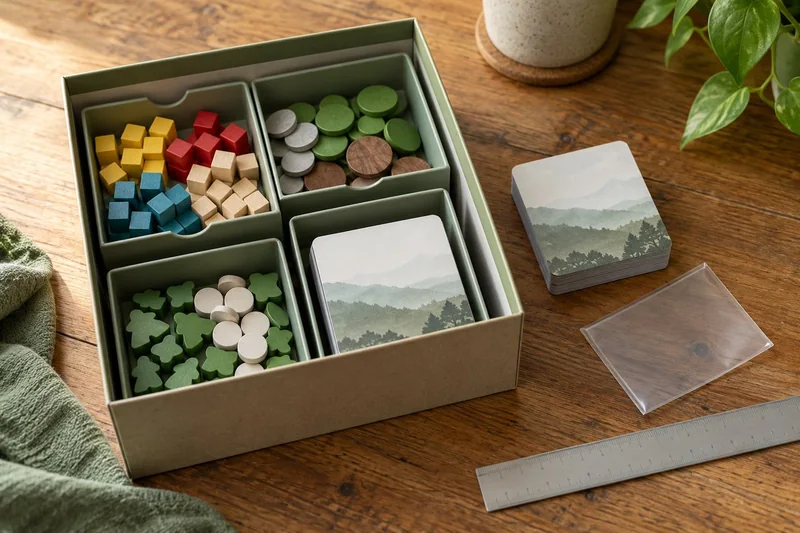
Ark Nova and Marine Worlds: when FS-ARNO is a sensible organizer choice
For standard components and sleeves within the maker’s stated specification, Folded Space FS-ARNO is a reasonable shortlist choice for Ark Nova plus…
Read the guide →