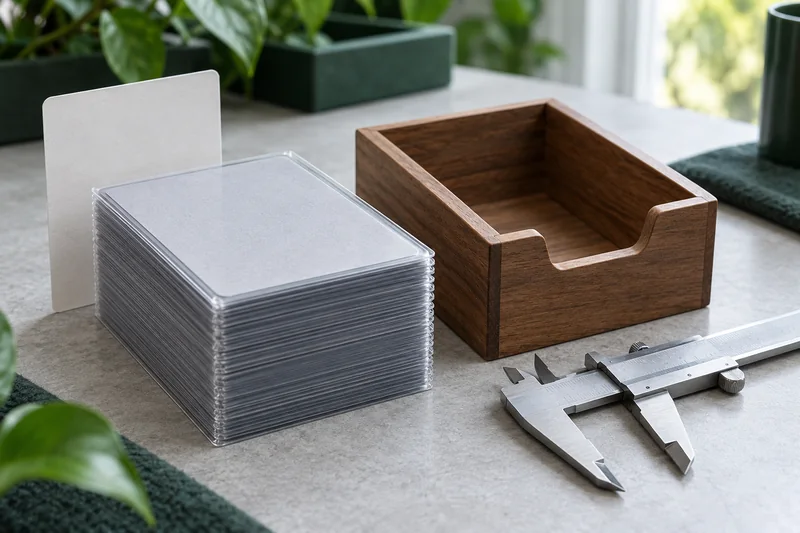
Short answer: Check two separate fits: the card inside the inner sleeve, then that sleeved card inside the outer sleeve and storage channel. A shared label such as “standard size” cannot establish all three.
Research guide · Sources checked October 18, 2026. The procedures and examples below are planning aids, not results from a hands-on product test.
On this page: Decide whether two layers solve your problem · Check the dimensions in the right order · Test a sample before sleeving the whole game · Recheck the whole closed box
Decide whether two layers solve your problem
Write down what you want to improve: handling during frequent shuffling, protection at the opening, or keeping a valuable deck together. Two sleeves also add material and can change how a deck handles. For an inexpensive, rarely played deck, a single suitable sleeve may be the more practical choice. This is a storage and selection workflow, not a claim that a sleeve makes cards waterproof.
Keep mini cards, square cards and large player cards on separate rows in your plan. Do not order one size for a game simply because its main deck uses that format. Start with our card sleeve selection guide if you have not identified the actual card dimensions.
Check the dimensions in the right order
Gamegenic lists its Inner Sleeves as 64 × 89 mm for cards up to 63 × 88 mm and describes them as an inner layer. That is a specific product example, not evidence that every sleeve marketed for standard cards will accept it. The outer sleeve still needs its own manufacturer guidance or a physical sample check.
| Check | Record | Stop if… |
|---|---|---|
| Card → inner | Card width and height; stated card-size limit | The card bows or needs force |
| Inner → outer | Exact product names; sleeve openings and clearance | The inner layer wrinkles or catches |
| Deck → insert | Full sleeved stack, dividers and usable channel | Lid pressure or trapped card edges appear |
Ask the sleeve maker about an unlisted combination. A printed sleeve dimension may describe the sleeve exterior rather than its usable interior. Do not treat subtracting two catalog widths as a reliable clearance calculation.
Test a sample before sleeving the whole game
- Use a spare card of the same dimensions first; keep the work surface clean and dry.
- Follow the sleeve manufacturer’s insertion instructions. Stop if corners catch or the card starts to bend.
- Compare a small group in both layers with the same number in a single layer. Let trapped air settle naturally; do not crush the stack.
- Check drawing, shuffling and access to the top and bottom cards.
- Measure the actual finished stack, including any dividers, before committing the remaining cards.
For a hypothetical storage check, suppose a completed deck measures 54 mm high and a channel has 52 mm of genuinely usable height. The deck does not fit that channel even if its card count is below an advertised box capacity. Those numbers illustrate the decision, not a measured product result.
Recheck the whole closed box
Place the sleeved deck, boards and all trays in their intended order. Close the lid without pushing down. Check neighboring compartments, because an overfilled card channel can shift a tray or leave components pressing on cards. Use the sleeve storage calculator for planning, then confirm the real stack; nominal film thickness does not include every air gap and seam.
If storage is too tight, first change the divider arrangement or use a separate deck container. Do not cut an insert or force a valuable deck into place based only on a volume estimate. The sleeved cards troubleshooting guide separates channel width, deck height and lid-clearance problems.
Sources and scope
- Gamegenic: Inner Sleeves — Manufacturer dimensions for this inner sleeve only; no universal outer-sleeve or insert compatibility claim.
Continue with your next check
Build on what you just learned
Your next useful step.
Choose sleeves, then check the complete deck.
Boulder 100+ or Bastion 100+ XL for a board-game deck?
Choose a rigid deck case around the finished sleeved stack and the way you remove cards.
Read the guide →
Board game card sleeves: size, thickness, and storage
Short answer. Match the sleeve to the card, then check the sleeved card and the full deck against the storage space. Card fit and…
Read the guide →