Evidence methodology · All tools
Measure a sample instead of assuming sleeve-film thickness
This calculator uses the height of a measured sample of actual sleeved cards. The sample should represent the same card construction, sleeve product and number of layers as the group you intend to store. Place it on a clean surface and let it settle naturally. Do not compress it with weights to produce a more favorable fit.
The model scales sample stack height by total card count divided by sample count. It then multiplies the projected stack height by the outside sleeved-card width and height to estimate a rectangular bounding volume. Cubic millimeters divided by 1000 give milliliters. Air gaps, seams, card variation and handling make this an estimate.
Illustrative reference: 50 sleeved cards form a 20 mm sample stack. For 200 equivalent cards, projected height is 20 × 200 ÷ 50 = 80 mm. At 66 × 91 mm outside dimensions, the bounding volume is 480,480 mm³, or 480.48 mL. Those are invented sample inputs, not a measured sleeve product result.
- Measure more than one representative sample if the stack varies.
- Add dividers and other stored objects as separate geometric requirements.
- Compare the actual channel width and height, not only total volume.
- Confirm the complete loaded stack and lid without pressure.
A 500 mL container can still reject this group if its opening is too narrow. See divider clearance and deck-box capacity claims for the limits that volume arithmetic cannot settle.
Build on what you just learned
Your next useful step.
Find components, rulebooks and the right expansion.
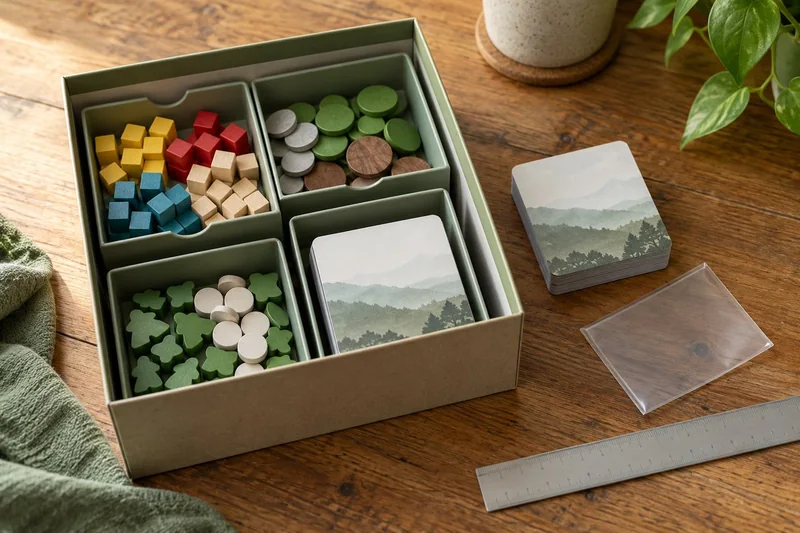
Wingspan Americas: update the storage plan before adding the new cards
Treat Americas as a mixed-component expansion, not simply another stack of bird cards.
Read the guide →
Wingspan Vision-Friendly Cards: replace the set without confusing the deck
If Wingspan’s card text is the obstacle, I would try the publisher’s Vision-Friendly cards before buying generic magnifiers or printing unofficial…
Read the guide →