
For a large collection of lightly handled board-game cards, I would start with an accurately sized lighter sleeve and reserve thicker sleeves for decks shuffled constantly. The saving is not only money: a thinner finished stack can keep an existing insert usable. Fit and handling still need a sample test.
On this page
Our recommendation
My choice for a lightly played, storage-constrained game is a sample of the lighter line. For a high-use draw deck, I would pay more only after confirming that the preferred thicker sleeve shuffles well and still fits.
Compare exact products, not “standard” labels
Sleeve Kings’ SKS-8810 page lists a 110-pack, 60-micron polypropylene sleeve for the 63.5 × 88 mm card format. Gamegenic’s Prime Board Game Sleeves are a thicker 100-micron line. These are different product specifications, not evidence that one will last a fixed number of times longer. Material thickness alone does not measure seam quality or your shuffle preference.
Use the same card format in a cost comparison and include delivery charges. A cheaper pack with the wrong width is wasted money. Avoid mixing visibly different backs in a deck where card identity must stay hidden, even if every card is technically covered.
Buy by use, then by packs
Separate frequently shuffled cards from setup-only reference cards. A deck handled every round has a different job from a reference card left beside the board. It can be sensible to sleeve only the shuffled deck first, provided the resulting backs remain consistent within each hidden-information group.
Use the Sleeve Pack Planner with real pack quantities. Include a deliberate spare allowance and inspect the leftovers. A 110-pack is not always cheaper than a 100-pack when the total crosses a purchase boundary, and buying an extra pack for three cards can reverse an apparent saving.
An illustrative buying calculation
For 205 cards plus five spares, two 110-packs provide 220 sleeves and leave ten unused. Three 100-packs provide 300 and leave ninety. With hypothetical prices of 4 and 6 currency units per pack, the totals are 8 and 18 before shipping. Those figures illustrate pack arithmetic; they are not current shop prices or a durability comparison.
Before you act
- Calculate whole packs, including spares.
- Keep different sleeve batches out of the same hidden deck if backs differ.
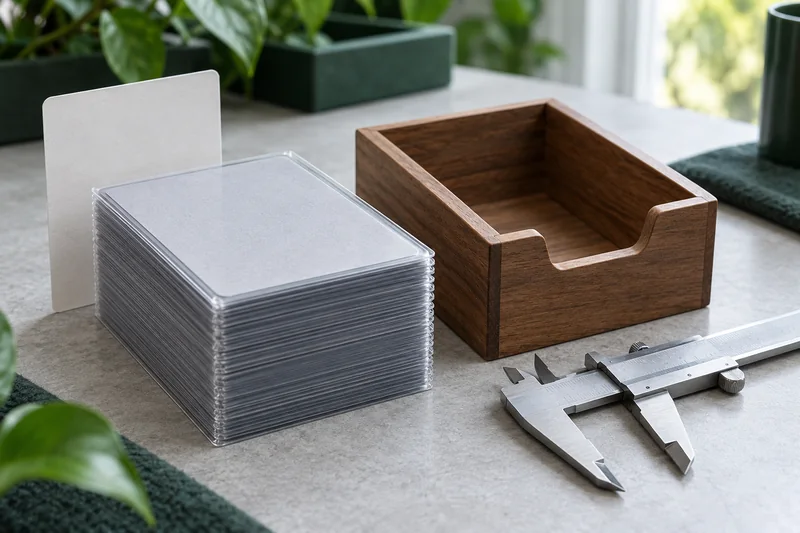
- Measure a sample stack instead of multiplying nominal film thickness.
Use the Sleeve Pack Planner to apply the guide to your own setup.
Keep exploring
Sources and research notes
Research checked on 21 October 2026. Product specifications are manufacturer statements; examples and buying judgements are our analysis. No hands-on product test is implied.
Build on what you just learned
Your next useful step.
Choose sleeves, then check the complete deck.
Boulder 100+ or Bastion 100+ XL for a board-game deck?
Choose a rigid deck case around the finished sleeved stack and the way you remove cards.
Read the guide →
Board game card sleeves: size, thickness, and storage
Short answer. Match the sleeve to the card, then check the sleeved card and the full deck against the storage space. Card fit and…
Read the guide →