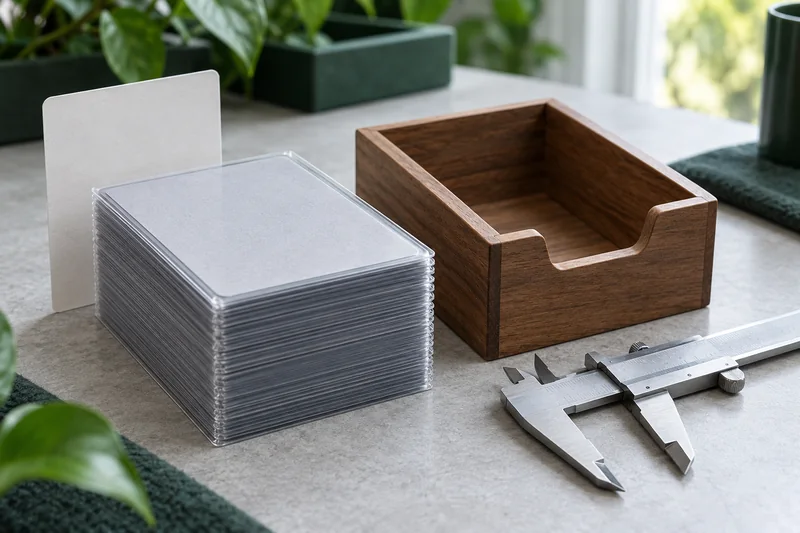
Compare sleeve backs, edges and wear before combining old and new packs in a hidden-information deck. I would replace or regroup the complete relevant deck when differences make cards recognisable. The same product name does not prove every batch looks identical after use.
On this page
Our recommendation
I favour a consistent hidden deck over squeezing the last use out of visibly different sleeves. Save the old ones for jobs where the difference does not reveal game information.
Inspect the information players can see
Look at the deck from the back and along the edges under normal lighting. Compare a new sleeve with a heavily handled one, then inspect a small mixed stack. Scratches, clouding, seam shape or colour variation can make a subgroup distinguishable even when no face is visible.
Focus on whether a player can infer information, not whether the sleeve is cosmetically perfect. A visible difference between public reference cards may be harmless, while a recognisable expansion card in a secret draw deck can affect play. Keep those use cases separate.
Make a fair replacement plan
Use spare sleeves from the same successful batch when possible, but still compare appearance after wear. If a consistent replacement cannot be achieved, resleeve the relevant hidden deck as a group. Keep old usable sleeves for non-secret aids or other appropriate tasks rather than mixing them blindly.
Record the line and purchase batch in the inventory if the game is important enough to maintain that detail. Do not attach identifying marks to hidden card backs as a substitute for a missing component. Any deliberate adaptation that changes information should be agreed openly by the group.
A simple blind grouping test
Put ten new and ten worn empty sleeves around identical blank cards. Shuffle them face down and see whether you can separate the groups by backs or edges without turning them over. If the separation is easy, do not use the two groups to identify base-game and expansion cards in a hidden deck.
Before you act
- Compare backs and edges under actual lighting.
- Separate public aids from secret decks.
- Check wear as well as the product label.
Use the Sleeve Pack Planner to apply the guide to your own setup.
Keep exploring
- Board game card sleeves: size, thickness, and storage
- Build a sleeve shopping list that does not overbuy every card format
Method note: this is an original planning procedure with illustrative inputs. It does not report a physical product test. Check the exact product, edition and official instructions before acting.
Build on what you just learned
Your next useful step.
Choose sleeves, then check the complete deck.
Boulder 100+ or Bastion 100+ XL for a board-game deck?
Choose a rigid deck case around the finished sleeved stack and the way you remove cards.
Read the guide →
Board game card sleeves: size, thickness, and storage
Short answer. Match the sleeve to the card, then check the sleeved card and the full deck against the storage space. Card fit and…
Read the guide →