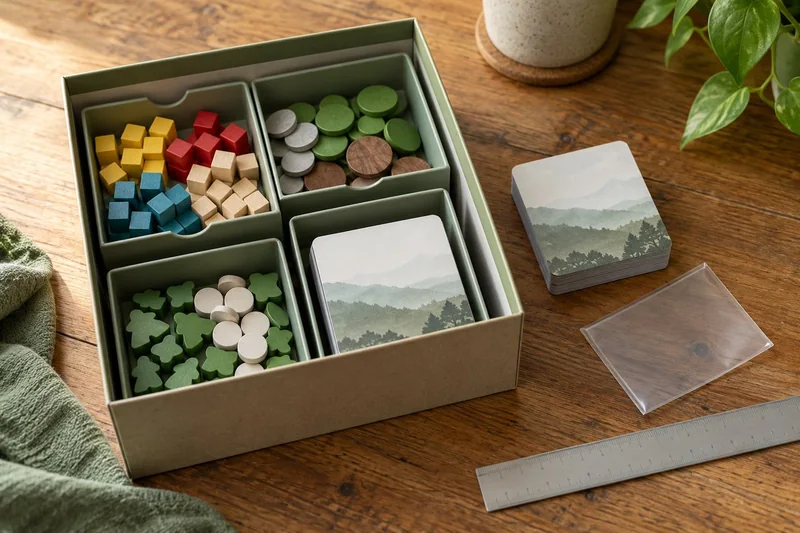
Answer: Make a concise loan card with the edition, separately stored items and a return checklist. Verify the starting contents together so a later discrepancy has a useful baseline.
BoardFit Atlas editorial project · Updated October 21, 2026 · Original decision framework and illustrative example. No physical product measurement or hands-on benchmark is claimed.
On this page: Why the distinction matters · A practical sequence · Decision record · Worked example · Verify the result · Question and answer · Sources and scope
Why the distinction matters
A full inventory can be too long for an ordinary loan. Select the pieces most likely to remain outside the main box: rulebooks, player pouches, extra decks and campaign logs. Record the packing order in a photo for private reference. Keep the loan record limited to what is needed for the agreement; a public collection spreadsheet does not need a borrower’s contact details or address.
A practical sequence
- Confirm the exact game and expansion configuration being lent.
- Count the agreed high-risk groups and mark any existing omissions.
- Add the return date, separate locations and a packing photo reference.
- On return, check the same groups together and update the inventory before shelving.
Decision record
| Check | What it means | What to verify |
|---|---|---|
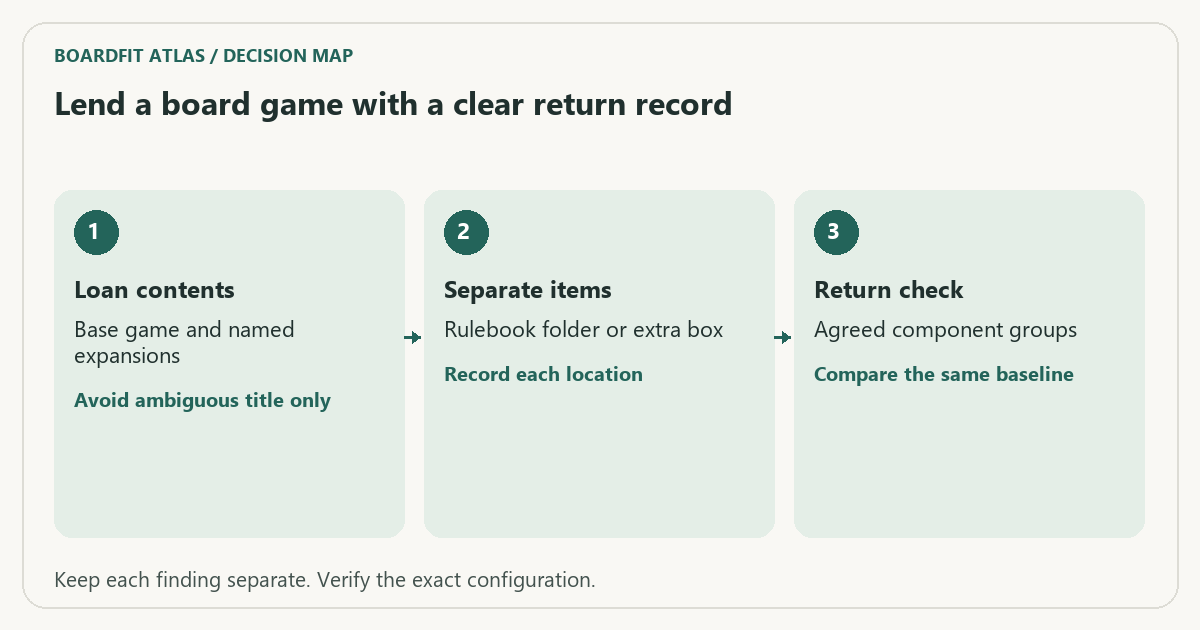
| Loan contents | Base game and named expansions | Avoid ambiguous title only |
| Separate items | Rulebook folder or extra box | Record each location |
| Return check | Agreed component groups | Compare the same baseline |
Worked example
A hypothetical loan includes the base box and a separate map folder. The box returns complete but the folder is still at the borrower’s home. A two-location card finds the issue before the next game night. A generic “game returned” tick would miss it even if the token count were correct.
Verify the result
Resolve discrepancies before marking the loan closed. If you use a temporary substitute, identify it in the record and explain it to the next players. The checklist supports a practical agreement; it is not an insurance valuation or proof of every component’s condition.
Download the editable CSV worksheet · Box-fit workbook
Question and answer
Should I recount every card for each loan? Choose a proportionate check with the borrower. Keep a full baseline available, but focus routine returns on groups likely to be separated.
Sources and scope
- Folded Space: Tapestry insert — An example of configuration-specific packing information, not universal insert compatibility.
The decision sequence, diagrams, worksheet and worked case are our editorial work. AI assisted research, drafting and implementation. Official references support the named technical distinctions; examples do not establish real product performance.
Continue the task
- Board game component inventory: check missing pieces before game night
- Prepare a board game for sale or donation with an honest contents note
- Browse the complete resource library
Build on what you just learned
Your next useful step.
Find components, rulebooks and the right expansion.
Wingspan Americas: update the storage plan before adding the new cards
Treat Americas as a mixed-component expansion, not simply another stack of bird cards.
Read the guide →
Wingspan Vision-Friendly Cards: replace the set without confusing the deck
If Wingspan’s card text is the obstacle, I would try the publisher’s Vision-Friendly cards before buying generic magnifiers or printing unofficial…
Read the guide →