
Answer: Match the design’s edition and sleeve assumptions, then verify a small representative part before committing material to the full insert. A model file is not evidence of your printer’s finished dimensions.
BoardFit Atlas editorial project · Updated October 21, 2026 · Original decision framework and illustrative example. No physical product measurement or hands-on benchmark is claimed.
On this page: Why the distinction matters · A practical sequence · Decision record · Worked example · Verify the result · Question and answer · Sources and scope
Why the distinction matters
A community design may have been built for another printing, expansion set or sleeve product. Its dimensions can also change when a slicer scale is altered. Read the design notes and list missing assumptions before choosing settings. Focus the first trial on the narrowest critical channel or largest supported component. Keep copyrighted game artwork and the creator’s license separate from the dimensional fit decision.
A practical sequence
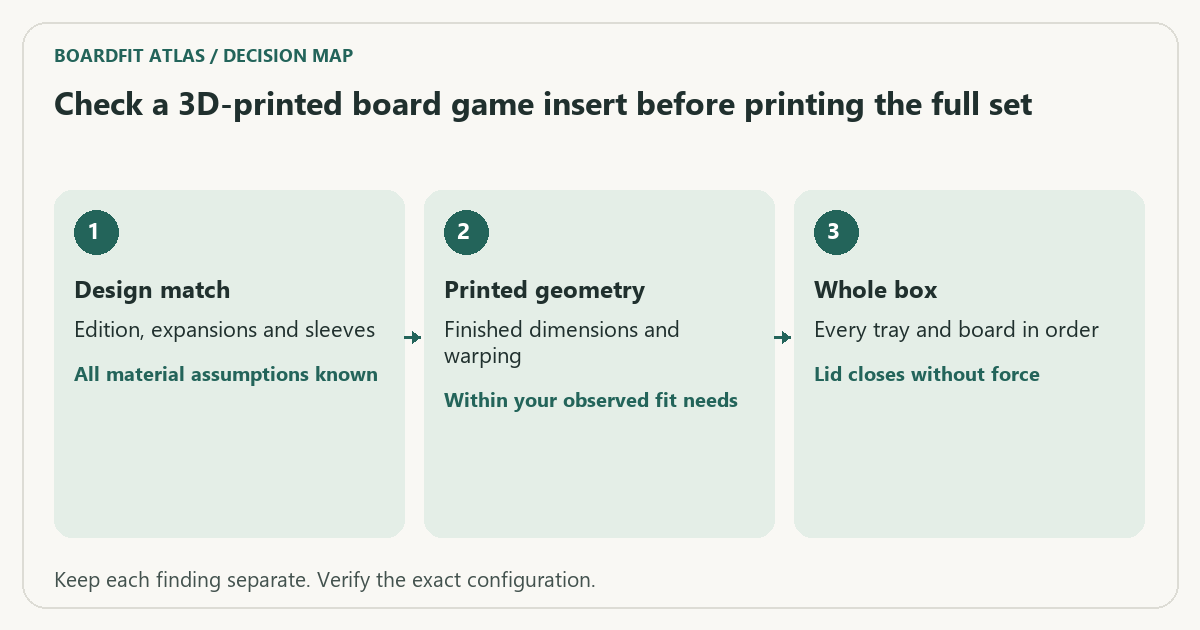
- Record the design version, license and stated game configuration.
- Compare the source dimensions with your measured usable box and components.
- Use the designer’s recommended orientation and a small representative part where provided.
- Measure the finished part and check its real contents before printing the remaining set.
Decision record
| Check | What it means | What to verify |
|---|---|---|
| Design match | Edition, expansions and sleeves | All material assumptions known |
| Printed geometry | Finished dimensions and warping | Within your observed fit needs |
| Whole box | Every tray and board in order | Lid closes without force |
Worked example
If an illustrative 100 mm model is scaled to 102%, its intended length becomes 102 mm before printing variation. That same change also affects every card channel and locating feature. Scaling the whole set to fix one tight feature may break another. Keep the original file and change only what the design permits and you can verify.
Verify the result
Keep slicer settings, filament and part version with the inventory. Treat a successful small trial as evidence for that part only; the full stack still needs closure and containment checks. No print settings here certify a material for archival contact.
Download the editable CSV worksheet · Box-fit workbook
Question and answer
Can I use a design for a different edition if the box looks identical? Compare the component and box differences explicitly. Similar artwork or outer size does not establish the same contents.
Sources and scope
- Folded Space: Tapestry insert — An example of configuration-specific packing information, not universal insert compatibility.
The decision sequence, diagrams, worksheet and worked case are our editorial work. AI assisted research, drafting and implementation. Official references support the named technical distinctions; examples do not establish real product performance.
Continue the task
- Will an insert fit your expansions? A verification checklist
- Plan a removable foamcore insert with real wall thickness
- Browse the complete resource library
Build on what you just learned
Your next useful step.
Choose trays around the way you actually play.
Token Silo or Token Silo XL? Choose the tray layout before the bigger box
I would choose the original Token Silo for a modest shared supply of small tokens, and the XL when long components or several card…
Read the guide →
Ark Nova and Marine Worlds: when FS-ARNO is a sensible organizer choice
For standard components and sleeves within the maker’s stated specification, Folded Space FS-ARNO is a reasonable shortlist choice for Ark Nova plus…
Read the guide →