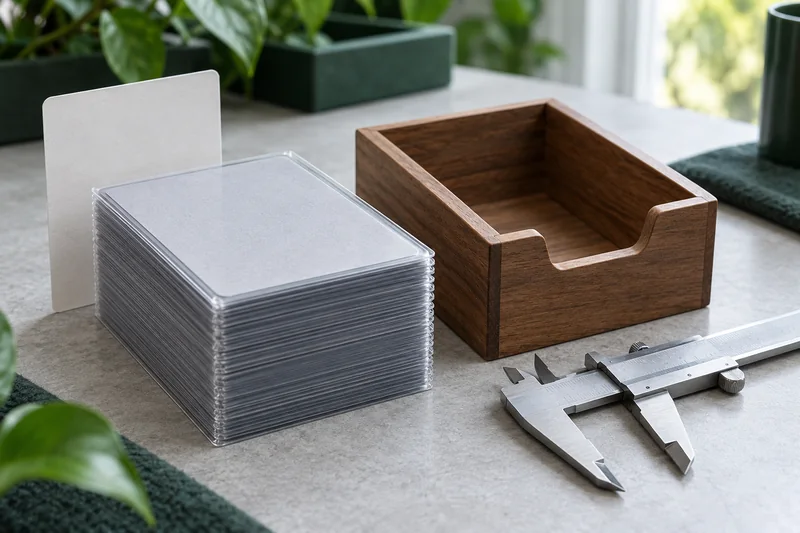
Answer: Check the whole loaded deck including the tallest divider tab. A card channel can accept the sleeved cards while the divider catches the lid or blocks adjacent trays.
BoardFit Atlas editorial project · Updated October 21, 2026 · Original decision framework and illustrative example. No physical product measurement or hands-on benchmark is claimed.
On this page: Why the distinction matters · A practical sequence · Decision record · Worked example · Verify the result · Question and answer · Sources and scope
Why the distinction matters
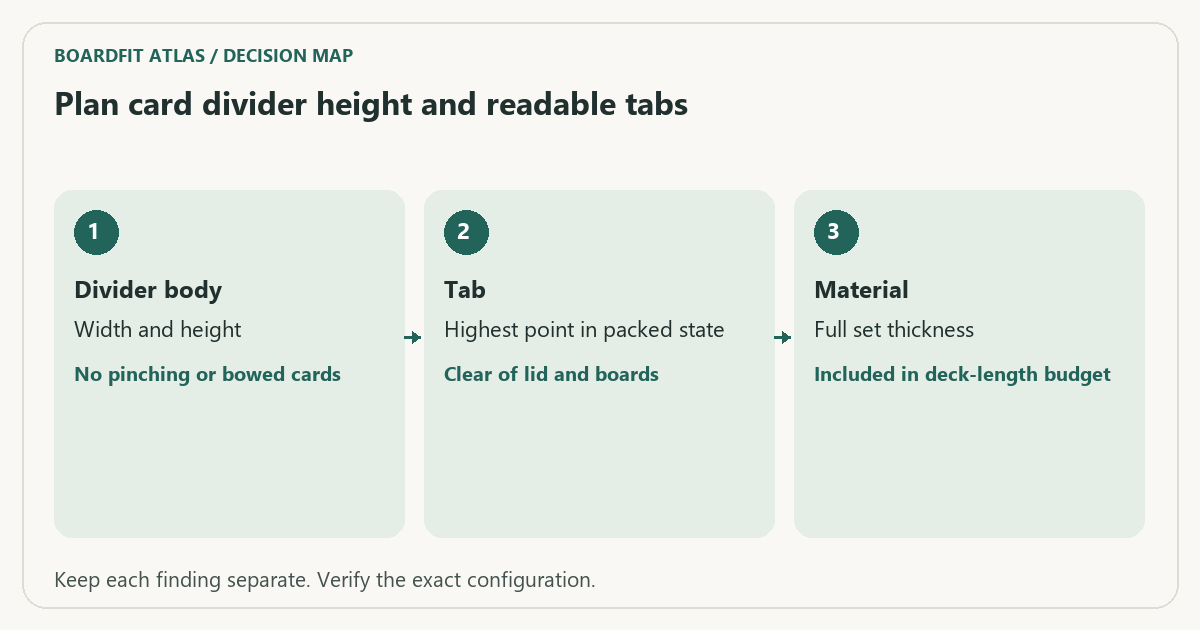
Divider width, body height, tab height and material thickness are separate dimensions. Start with a paper mock-up kept clear of valuable cards, then compare it to the closed-box packing order. Tall labels are easier to read only when the lid and neighboring components leave room. A label hidden under a board does not become useful simply because it is taller. Keep divisions aligned with the deck groups used during setup.
A practical sequence
- Measure the sleeved card envelope and the usable channel, including rounded or tapered walls.
- Make a mock divider with the proposed tab and label position.
- Place it in a representative loaded channel and inspect neighboring tray and lid clearance.
- Check whether the tab can be read and the deck removed without bending either.
Decision record
| Check | What it means | What to verify |
|---|---|---|
| Divider body | Width and height | No pinching or bowed cards |
| Tab | Highest point in packed state | Clear of lid and boards |
| Material | Full set thickness | Included in deck-length budget |
Worked example
Suppose a deck measures 91 mm high in its sleeves and the proposed tab adds 8 mm above it. The packed height becomes 99 mm at the tab, even though the cards remain 91 mm. In an illustrative 96 mm clear space, the tab fails first. Lowering or moving the label may solve the problem without changing sleeves.
Verify the result
Keep tab information short and consistent. If a divider needs pressure to sit below the lid, revise the design. Record the finished divider set in the box inventory so a later compatibility check does not assume bare cards.
Download the editable CSV worksheet · Box-fit workbook
Question and answer
Can a divider count toward a deck box’s advertised capacity? Its material takes space, so include it in your real loaded-stack measurement. A published card count may assume no dividers.
Sources and scope
- Gamegenic: sleeve and card size specifications — Dimensions describe the named products. Our packing decisions and examples are independent analysis.
The decision sequence, diagrams, worksheet and worked case are our editorial work. AI assisted research, drafting and implementation. Official references support the named technical distinctions; examples do not establish real product performance.
Continue the task
- Sleeved cards do not fit: diagnose the blocked dimension
- Read a deck box capacity claim before buying for a board game
- Browse the complete resource library
Build on what you just learned
Your next useful step.
Choose sleeves, then check the complete deck.
Boulder 100+ or Bastion 100+ XL for a board-game deck?
Choose a rigid deck case around the finished sleeved stack and the way you remove cards.
Read the guide →
Board game card sleeves: size, thickness, and storage
Short answer. Match the sleeve to the card, then check the sleeved card and the full deck against the storage space. Card fit and…
Read the guide →