
Answer: A second row is useful only if you can identify and retrieve it without unloading an awkward stack. Allocate depth to both packed boxes, the real obstruction at the back and your retrieval method.
BoardFit Atlas editorial project · Updated October 21, 2026 · Original decision framework and illustrative example. No physical product measurement or hands-on benchmark is claimed.
On this page: Why the distinction matters · A practical sequence · Decision record · Worked example · Verify the result · Question and answer · Sources and scope
Why the distinction matters
Shelf depth is often measured with an empty ruler against the front edge. The installed space may include a back panel, skirting, plugs or a door. Then there is the operational problem: a box behind another box is invisible. Decide which games deserve immediate access and which can be occasional retrievals. A location label should name both rows, not merely the cube. Avoid balancing a back row on loose objects to make titles visible.
A practical sequence
- Measure usable depth from the front boundary you intend to keep clear to the first real obstruction.
- Arrange a supported trial with the actual packed boxes. Include lid protrusions and any protective outer case.
- Label positions front and back. Put the back-row titles on a removable shelf card and record them in the inventory.
- Retrieve one back-row game as you would on game night. Revise the plan if you need an unstable temporary pile.
Decision record
| Check | What it means | What to verify |
|---|---|---|
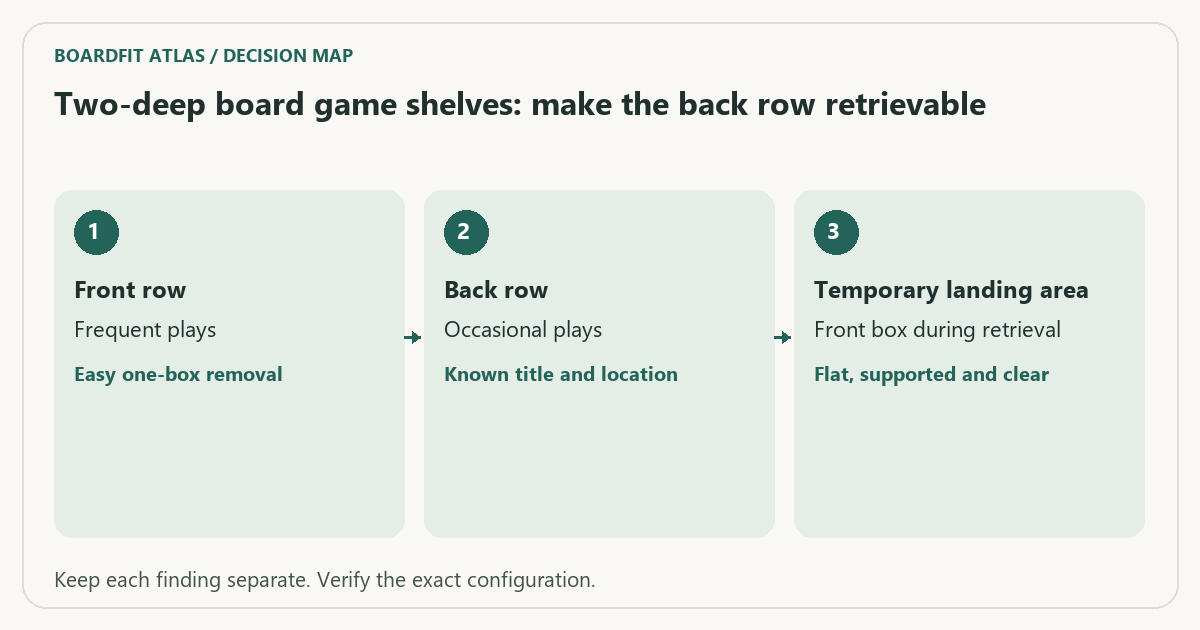
| Front row | Frequent plays | Easy one-box removal |
| Back row | Occasional plays | Known title and location |
| Temporary landing area | Front box during retrieval | Flat, supported and clear |
Worked example
A hypothetical 380 mm usable shelf accepts boxes 170 mm and 180 mm deep with 30 mm left over. That arithmetic establishes combined depth only. If a door hinge occupies the remaining space or the front box cannot be lifted cleanly, the practical plan still fails. Try a single row for the largest games and reserve two-deep storage for compatible smaller boxes.
Verify the result
Update both the visible shelf card and digital inventory when a title moves. Keep the landing space available, or acknowledge that the arrangement is archive storage rather than everyday access. Check the total load independently.
Download the editable CSV worksheet · Box-fit workbook
Question and answer
Does spare depth guarantee space for two rows? No. Width, height, loading and retrieval also matter. Test the entire movement of a packed box.
Sources and scope
- IKEA US: KALLAX buying guide, January 2026 — Manufacturer dimensions and installation guidance; measure your installed unit and read its own instructions.
The decision sequence, diagrams, worksheet and worked case are our editorial work. AI assisted research, drafting and implementation. Official references support the named technical distinctions; examples do not establish real product performance.
Continue the task
- Board game storage in a small apartment: plan access first
- Allow retrieval clearance around a tightly fitted game box
- Browse the complete resource library
Build on what you just learned
Your next useful step.
Leave space for retrieval, growth and a safe load.

Is the Wingspan Nesting Box worth the shelf space?
I would consider the Nesting Box for a Wingspan collection that is already spread across several frequently used boxes.
Read the guide →Allow retrieval clearance around a tightly fitted game box
Measure the box in its packed state, then reserve space for your actual grip and removal path. Zero geometric clearance can leave a box…
Read the guide →