
Answer: A box can fit geometrically while the collection exceeds the furniture’s documented load. Keep a separate weight ledger for each loaded surface and use the instructions for the exact unit.
BoardFit Atlas editorial project · Updated October 21, 2026 · Original decision framework and illustrative example. No physical product measurement or hands-on benchmark is claimed.
On this page: Why the distinction matters · A practical sequence · Decision record · Worked example · Verify the result · Question and answer · Sources and scope
Why the distinction matters
Begin with the shelving model and its assembly instructions. Overall furniture dimensions do not establish the usable opening, and a load printed for one surface cannot be assigned to every compartment. Include baskets, doors, trays and any objects sharing the surface. Weigh the packed games rather than estimating from their box size. This separates two questions that are often mixed together: can the box enter the opening, and is the installed furniture intended to carry that load?
A practical sequence
- Record the exact furniture product, installed orientation and the load wording from its instructions. Resolve whether it applies per shelf, surface or unit.
- Weigh each packed game and accessory in the units used by that instruction. Add a location code so you can reproduce the total.
- Add the loads that act on the relevant surface. Compare with the documented allowance, retaining practical room for later additions.
- Follow the manufacturer’s installation and restraint instructions. Recalculate after moving games or adding an organizer.
Decision record
| Check | What it means | What to verify |
|---|---|---|
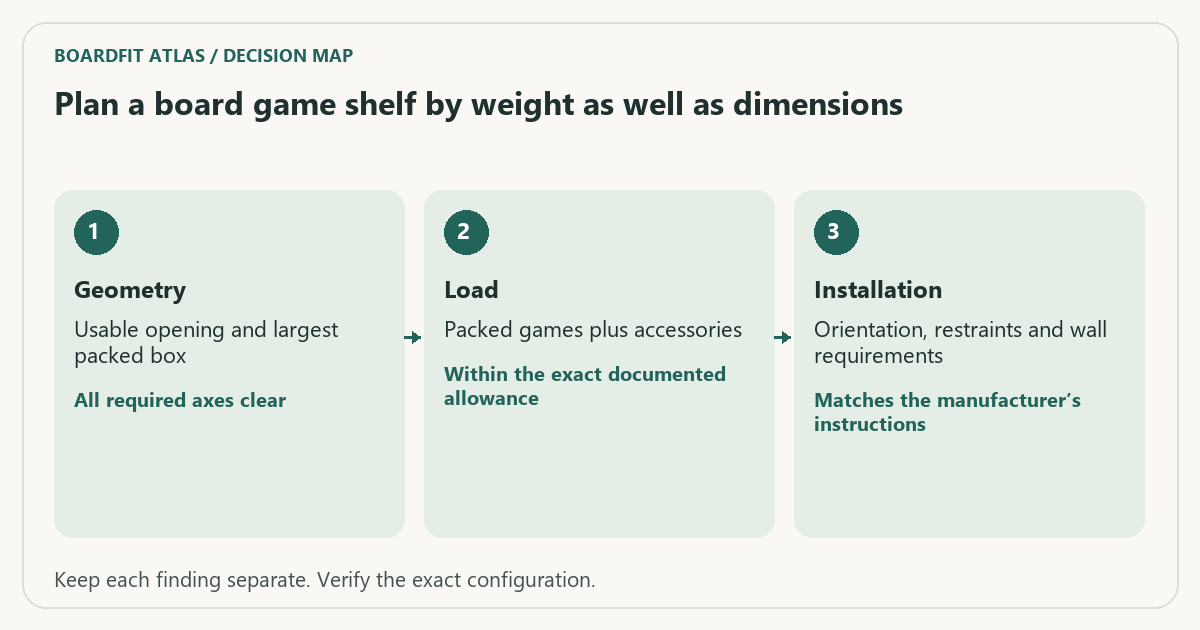
| Geometry | Usable opening and largest packed box | All required axes clear |
| Load | Packed games plus accessories | Within the exact documented allowance |
| Installation | Orientation, restraints and wall requirements | Matches the manufacturer’s instructions |
Worked example
Illustrative numbers: six games at 1.7 kg each plus a 0.8 kg basket total 11.0 kg. If the relevant documented allowance were 10 kg, the location would fail the load check even with spare geometric room. That 10 kg is an invented example, not an IKEA specification. Moving one game elsewhere changes the load, while rotating a box does not change its mass.
Verify the result
Save the ledger with the furniture instructions. A photo of a tidy shelf cannot establish its loading, and the box-fit calculator does not evaluate structural capacity. If you cannot determine how an allowance applies, ask the furniture manufacturer before using the location.
Download the editable CSV worksheet · Box-fit workbook
Question and answer
Should I divide the unit’s total load by the number of cubes? Only when the manufacturer explicitly defines the load that way. A convenient division is not evidence about the structure.
Sources and scope
- IKEA US: KALLAX buying guide, January 2026 — Manufacturer dimensions and installation guidance; measure your installed unit and read its own instructions.
The decision sequence, diagrams, worksheet and worked case are our editorial work. AI assisted research, drafting and implementation. Official references support the named technical distinctions; examples do not establish real product performance.
Continue the task
- Board game storage: build a system that fits
- Two-deep board game shelves: make the back row retrievable
- Browse the complete resource library
Build on what you just learned
Your next useful step.
Leave space for retrieval, growth and a safe load.
Is the Wingspan Nesting Box worth the shelf space?
I would consider the Nesting Box for a Wingspan collection that is already spread across several frequently used boxes.
Read the guide →
Allow retrieval clearance around a tightly fitted game box
Measure the box in its packed state, then reserve space for your actual grip and removal path. Zero geometric clearance can leave a box…
Read the guide →